
What Are Espresso Pods? E.S.E. Size, Machines & Compatibility
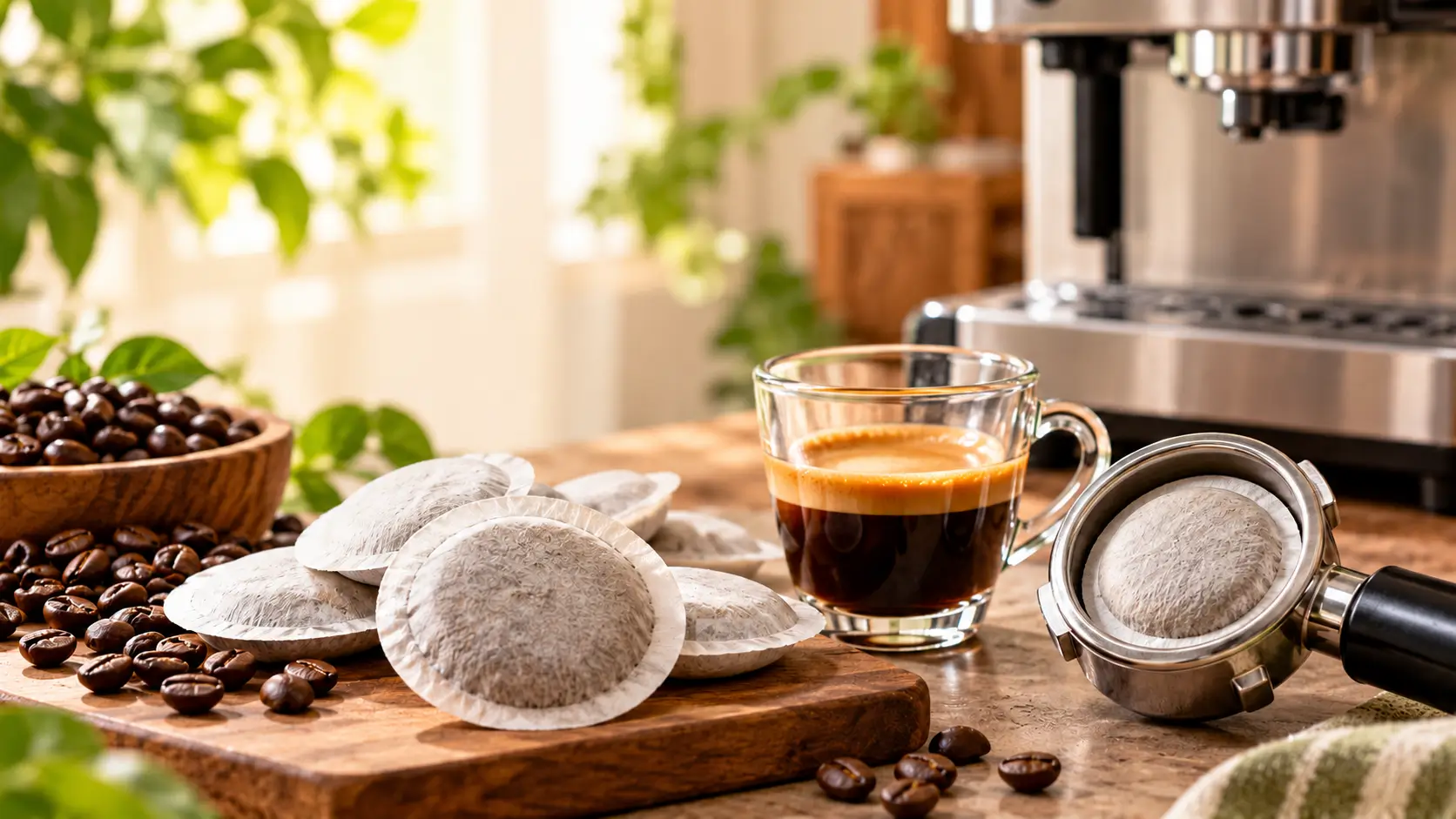
Espresso pods usually refer to E.S.E. paper pods: pre-measured, pre-tamped servings of ground coffee designed for compatible espresso ↗ machines. E.S.E. stands for Easy Serving Espresso.
The current E.S.E. standard uses a 7-gram serving sealed between two layers of filter paper. The standard pod diameter is tightly controlled at about 43.5 to 44.5 mm, which is why E.S.E.-compatible machines from different brands can use the same open pod format.
This is different from Nespresso, Lavazza and Dolce Gusto capsules. Those are rigid capsule systems with their own machine designs. They may make espresso-style drinks, but they should not be treated as the same physical format as an E.S.E. paper espresso pod.
Important Note
“Espresso pod” and “espresso capsule” are often used loosely in stores, but they are not always the same thing. On this page, “espresso pod” mainly means the standardized E.S.E. paper pod. Nespresso and other rigid capsules are included only for comparison.
Key Takeaways
- E.S.E. stands for Easy Serving Espresso.
- An E.S.E. serving contains about 7 g of ground, compressed coffee between filter-paper layers.
- The current standard specifies a pod diameter of about 43.5–44.5 mm.
- E.S.E. is an open standard, so certified pods and machines from different brands can be compatible.
- An illy E.S.E. preparation guide uses about 20–25 seconds for roughly 25 ml of espresso from one pod.
- SENSEO-style soft pods are different: current SENSEO machines use about 1 bar and make café-crème-style coffee rather than E.S.E. espresso.
- Nespresso Original capsules are rigid proprietary capsules and use a separate 19-bar extraction system.
- Do not force an E.S.E. pod into a Nespresso, Keurig, Vertuo or other incompatible holder.
Quick Answer
An E.S.E. espresso pod is a standardized paper pod containing about 7 g of pre-ground, pre-tamped coffee. It is approximately 44 mm wide and is designed for an E.S.E.-compatible espresso holder or machine. It is not interchangeable with Nespresso capsules, Vertuo capsules, K-Cups or SENSEO soft pods.
What Are Espresso Pods?
The term “espresso pod” can be confusing because retailers sometimes use it for several single-serve products.
The clearest technical meaning is the E.S.E. paper pod. It contains a single pre-portioned dose of roasted, ground and compressed coffee sealed between two layers of food-grade filter paper.
This removes several steps that traditional espresso requires:
- No measuring the dose.
- No grinding immediately before brewing.
- No manual distribution.
- No manual tamping.
- Less loose coffee around the machine.
You still need a machine or filter holder specifically designed for the E.S.E. standard.
What Is the E.S.E. Standard?
E.S.E. means Easy Serving Espresso. It is an international open industry standard for espresso made from paper servings.
The important word is open. Unlike many capsule systems, the E.S.E. format is not limited to one single coffee brand or one single machine manufacturer. Certified pod and machine makers can design products around the same standard.
The E.S.E. standard covers more than pod width. It also controls technical and functional characteristics such as:
- Pod geometry.
- Coffee dose.
- Grinding and compression.
- Machine extraction chamber.
- Temperature and pressure performance.
- Finished espresso quality.
How to Check Compatibility
Look for E.S.E. or Easy Serving Espresso on both the coffee package and machine/holder documentation. A round paper pod that looks similar is not enough proof.
What Size Is an E.S.E. Espresso Pod?
The current E.S.E. standard narrows the accepted pod diameter to about 43.5–44.5 mm. The allowed thickness range is about 9.1–10.6 mm.
The standard serving contains 7 g of coffee.
| E.S.E. Specification | Typical Standard |
|---|---|
| Pod type | Round paper espresso serving |
| Diameter | 43.5–44.5 mm |
| Thickness | 9.1–10.6 mm |
| Coffee dose | 7 g |
| Use | One pod for one espresso serving |
| Machine | E.S.E.-compatible espresso machine or holder |
How Do E.S.E. Espresso Pods Work?
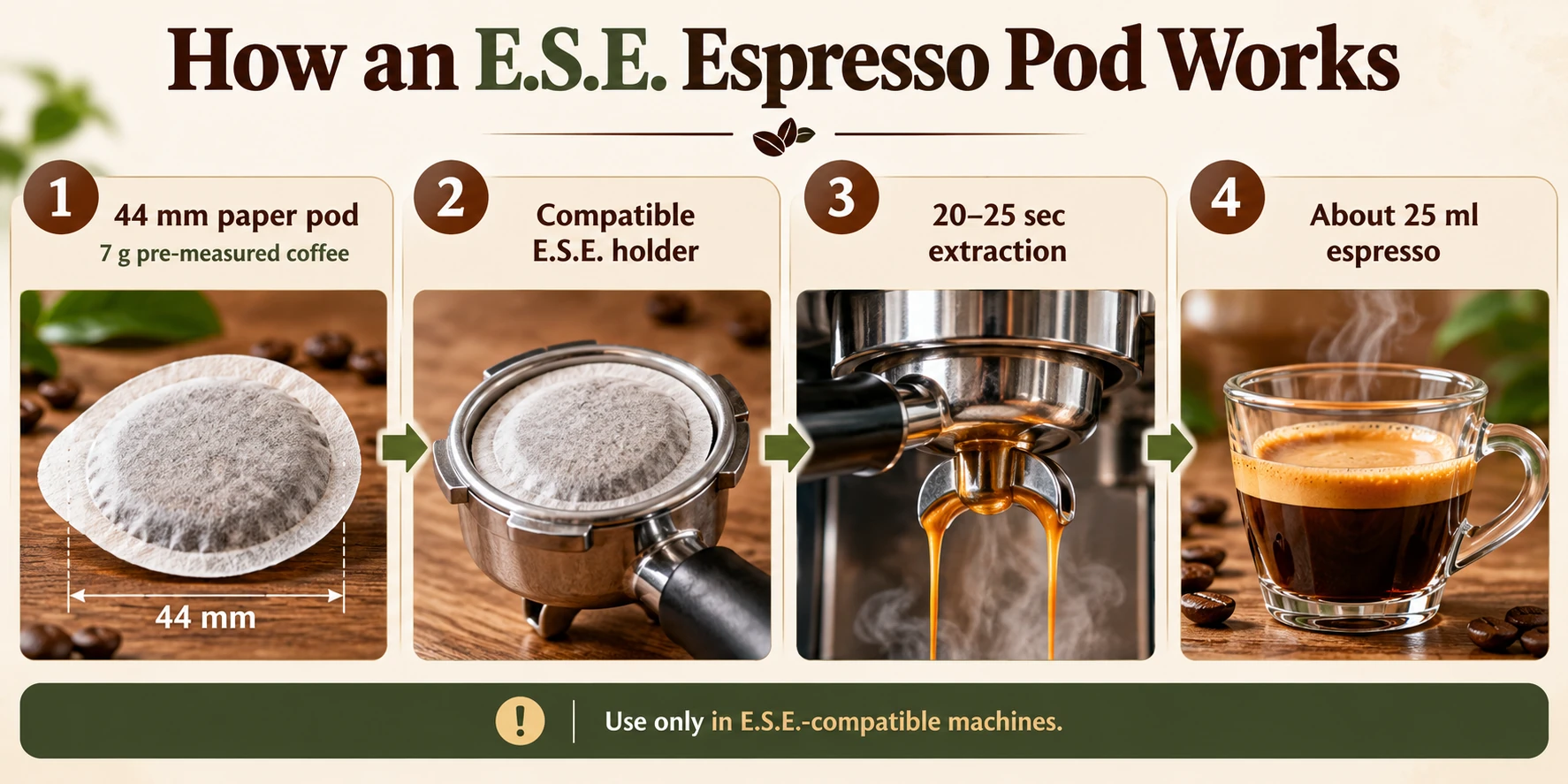
The paper pod is already dosed, compressed and shaped for a compatible extraction chamber.
One E.S.E. pod is intended for one espresso. If you want a double, use two fresh servings rather than brewing the same pod twice.
Why Does Pressure Matter for Espresso Pods?
Espresso is not just “strong coffee.” The brew method uses a controlled combination of finely ground coffee, temperature, pressure and a short extraction time.
Compatible E.S.E. espresso equipment is tested around defined machine parameters so the standardized paper serving can produce a repeatable espresso.
For context, illy’s professional E.S.E. machine guidance shows active high-pressure operation around the espresso range. This is very different from a low-pressure SENSEO brewer.
E.S.E. Espresso
Designed for espresso extraction in a compatible espresso chamber with a pre-compressed 7 g paper pod.
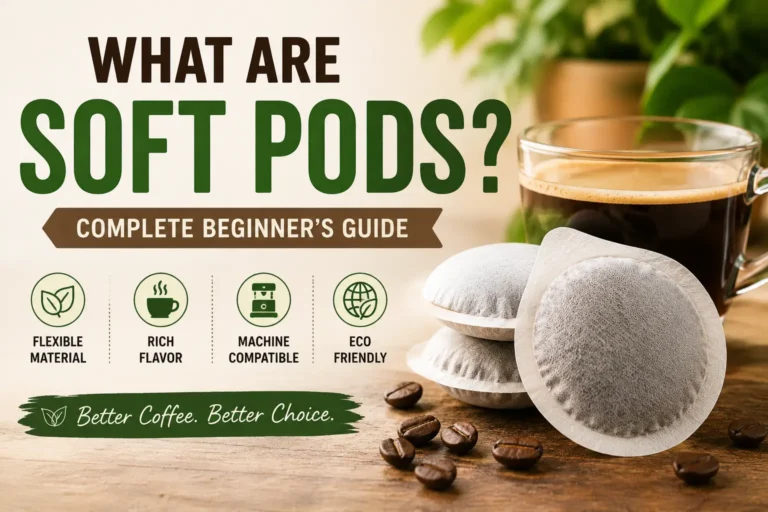
SENSEO Coffee Pad
Current Philips SENSEO Original machines list about 1 bar pump pressure and make café-crème-style coffee.
E.S.E. Espresso Pods vs Soft Coffee Pods
Both can be made from filter paper, but they are not the same format.
| Feature | E.S.E. Espresso Pod | SENSEO-Style Soft Pod |
|---|---|---|
| Main drink | Espresso | Café-crème / longer coffee |
| Standard size | About 44 mm | Different format; do not use 44 mm as a universal soft-pod rule |
| Coffee dose | 7 g standard serving | Product/system specific |
| Brewing pressure | Espresso-range compatible equipment | About 1 bar on current SENSEO Original machines |
| Interchangeable? | No | |
See What Are Soft Coffee Pods? ↗ for the full comparison.
Espresso Pods vs Coffee Capsules
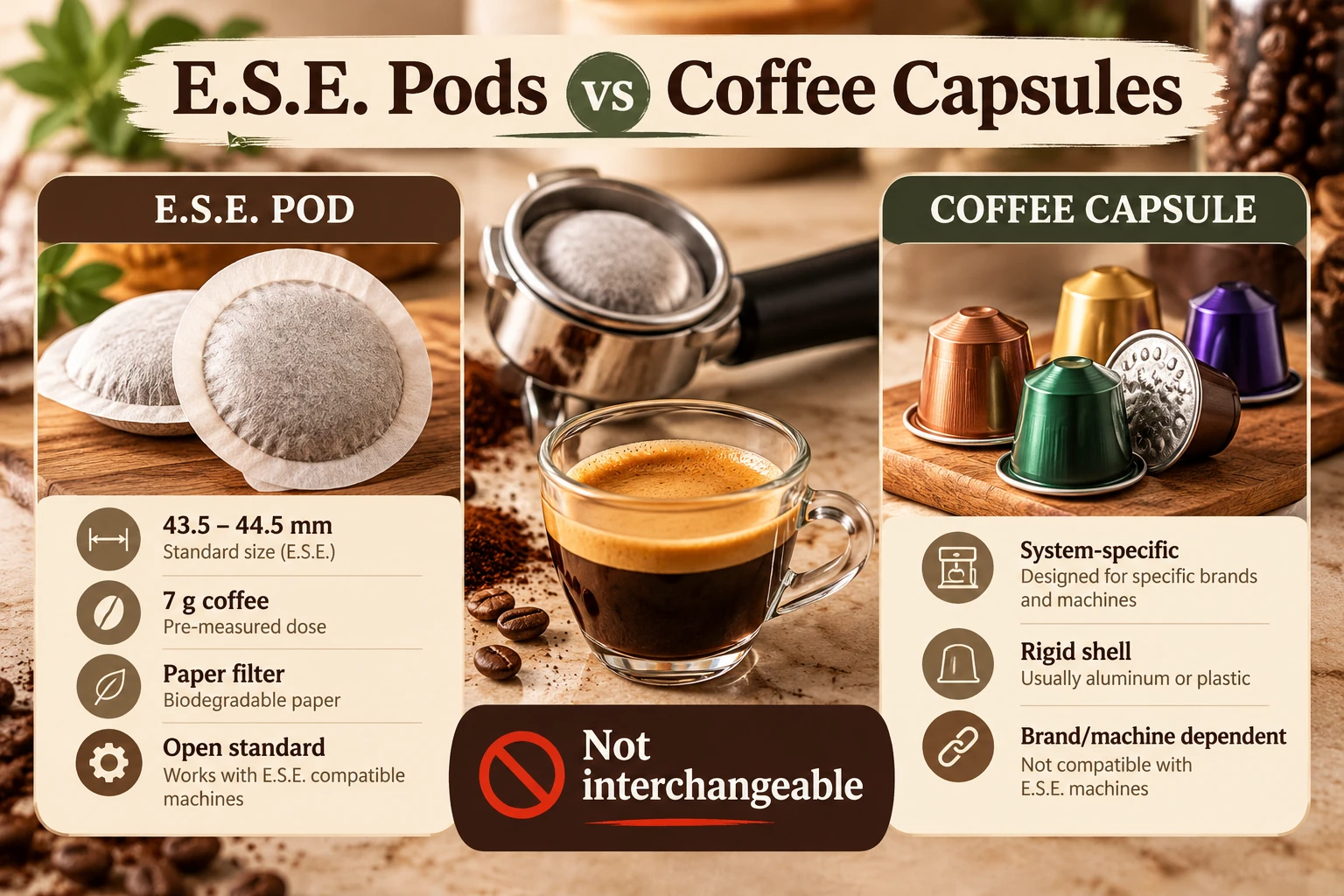
Many beginners use “pod” and “capsule” as if they mean the same thing. In casual conversation that happens often, but the physical systems can be very different.
| Feature | E.S.E. Pod | Rigid Capsule |
|---|---|---|
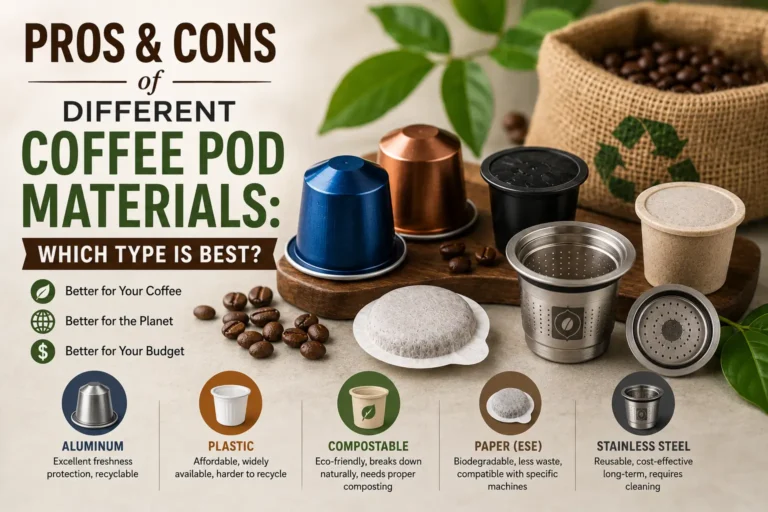
| Structure | Filter-paper serving | Rigid aluminum, plastic or other capsule |
| Standardization | Open E.S.E. industry standard | Usually system/brand specific |
| Coffee dose | 7 g standard serving | Varies by system and capsule |
| Freshness barrier | Usually depends on an individual outer wrapper | Rigid sealed capsule itself can provide a strong barrier |
| Machine fit | E.S.E.-compatible holder | Exact capsule family required |
E.S.E. Pods vs Nespresso Capsules
Nespresso Original is a separate capsule system. Nespresso says Original machines use 19 bars of pressure and are designed for Original capsules.
Vertuo is different again. Vertuo capsules carry barcodes and the machine uses Centrifusion technology to set extraction for each capsule.
| Feature | E.S.E. | Nespresso Original | Nespresso Vertuo |
|---|---|---|---|
| Format | Paper pod | Rigid capsule | Barcode-based rigid capsule |
| System type | Open standard | Proprietary capsule family | Proprietary capsule family |
| Brewing approach | Espresso extraction | 19-bar pressure extraction | Centrifusion |
| Interchangeable? | No | ||
For the capsule family, see Nespresso Coffee Pods ↗.
What About Lavazza, Dolce Gusto and Other Espresso Capsules?
They can make concentrated or espresso-style coffee, but they should not automatically be called E.S.E. espresso pods.
- Lavazza: sells several coffee formats and capsule systems. Compatibility depends on the exact product line.
- Dolce Gusto: uses its own rigid capsule system for coffee and specialty drinks.
- Nespresso: uses Original or Vertuo capsule families.
- E.S.E.: uses the open 44 mm paper-pod standard.
The safest buying habit is to start with the machine model, not with the word “espresso.”
What Do E.S.E. Espresso Pods Taste Like?
E.S.E. pods can produce a concentrated espresso with crema when the coffee, machine and extraction are working correctly.
Taste still depends on:
- Arabica/Robusta blend.
- Roast level.
- Freshness.
- Pod storage.
- Machine temperature and cleanliness.
- Espresso volume.
A dark roast is not automatically better. It may taste more roasted or intense, while medium roasts can show more sweetness and origin character.
For roast and intensity differences, see Coffee Pods by Roast Type ↗ and Coffee Pods Flavor & Intensity ↗.
How Much Caffeine Is in an Espresso Pod?
There is no single caffeine number for every E.S.E. pod.
The serving is standardized around 7 g of coffee, but caffeine changes with:
- Arabica vs Robusta content.
- Coffee blend.
- Roast and processing.
- Extraction conditions.
Robusta-heavy blends generally contain more caffeine than Arabica-heavy blends.
See Caffeine in Coffee Pods ↗.
Which Machines Use E.S.E. Espresso Pods?
You need either:
- A dedicated E.S.E. pod machine.
- An espresso machine with an E.S.E.-compatible filter basket or adapter.
- A portable espresso maker specifically designed for E.S.E. pods.
Illy currently sells dedicated E.S.E. equipment, and its professional documentation also describes an E.S.E. adapter for compatible espresso equipment.
Machines That Are Not Automatically E.S.E.-Compatible
Nespresso Original, Nespresso Vertuo, Keurig K-Cup brewers and SENSEO machines use different pod/capsule systems. Do not insert an E.S.E. pod unless the machine documentation specifically supports E.S.E.
Is Keurig K-Café an Espresso Pod Machine?
No. Keurig K-Café uses K-Cup pods. Its concentrated coffee setting can be useful for milk-based drinks, but it is not an E.S.E. espresso-pod system.
Can a De’Longhi Espresso Machine Use E.S.E. Pods?
Some De’Longhi espresso machines support E.S.E. pods through the correct filter basket, while others may not. Check the exact model manual rather than assuming compatibility from the brand name.
How to Use an E.S.E. Espresso Pod
How Long Do Espresso Pods Stay Fresh?
The paper E.S.E. serving itself is permeable, so freshness normally depends on the sealed outer wrapper.
Store unopened pods:
- In a cool, dry place.
- Away from direct sunlight.
- Away from heat and strong odors.
- Inside the original sealed packaging until needed.
Use the manufacturer’s best-before date rather than a universal shelf-life number.
See How Long Do Coffee Pods Last? ↗.
Can You Reuse an E.S.E. Espresso Pod?
No. A standard E.S.E. pod is a single-use serving.
Illy’s preparation guidance says one pod makes one espresso and should not be used twice. A second extraction will usually be weak and over-extracted because much of the soluble coffee has already been removed.
If your goal is reuse, a purpose-built reusable accessory is a different product category. See Refillable Coffee Pods ↗.
Are E.S.E. Pods Eco-Friendly?
E.S.E. pods use filter paper rather than a rigid plastic or aluminum shell, which can reduce the amount of rigid packaging in the used serving.
But do not assume every E.S.E. pod is automatically home compostable. The paper, seal material, coffee grounds and certification all matter.
Check the exact pack for:
- Home-compostable certification.
- Industrial-compostable certification.
- General waste instructions.
- Outer-wrapper disposal instructions.
See Compostable Coffee Pods ↗, Biodegradable Coffee Pods ↗, and How to Recycle Coffee Pods ↗.
Common Espresso Pod Problems
Weak or Watery Espresso
- Using the wrong pod format.
- Running too much water through one serving.
- Using an old or damaged pod.
- Machine temperature or extraction problems.
Very Slow Flow
- The pod may be seated incorrectly.
- The holder may be dirty or blocked.
- The machine may need cleaning or descaling.
- An incompatible paper pod may be restricting the chamber.
Bitter Espresso
Bitterness can come from dark roasting, excessive extraction, stale coffee or a dirty machine. It does not automatically mean the E.S.E. format is the problem.
Little or No Crema
Crema depends on coffee freshness, blend, roast, machine conditions and extraction. Factory-sealed rigid capsules may create a different crema appearance from paper E.S.E. pods.
Pod Does Not Fit
Stop and check the format. Do not cut, fold or force the serving into a machine that is not designed for E.S.E.
What to Check Before Buying Espresso Pods
| Check | Why It Matters |
|---|---|
| E.S.E. logo / compatibility | Confirms the paper pod is intended for the E.S.E. system |
| Machine manual | Shows whether your machine or basket supports E.S.E. |
| Coffee blend | Arabica/Robusta ratio affects flavor, body and caffeine |
| Roast | Changes flavor and perceived intensity |
| Individual wrapping | Helps protect a paper pod from oxygen and moisture |
| Best-before date | Useful for freshness management |
| Disposal claim | Paper does not automatically mean home compostable |
| Cost per serving | Lets you compare E.S.E. with capsules and beans fairly |
For cost comparison, see Coffee Pods Cost Per Cup ↗.
Frequently Asked Questions
E.S.E. stands for Easy Serving Espresso, an open standard for paper espresso pods and compatible espresso machines.
The current E.S.E. standard specifies a diameter of about 43.5 to 44.5 mm and a thickness of about 9.1 to 10.6 mm.
A standard E.S.E. serving contains 7 g of ground, compressed coffee.
No. E.S.E. uses a standardized paper pod, while Nespresso uses rigid proprietary capsule systems.
No. SENSEO-style pads are designed for low-pressure coffee-pad machines, while E.S.E. pods are designed for espresso extraction.
No. The machine needs a dedicated E.S.E. holder, basket or adapter. Check the exact model documentation.
No. Nespresso Original and Vertuo use different rigid capsule formats.
No. Keurig brewers use K-Cup-style pods and do not use the 44 mm E.S.E. paper standard.
Illy’s E.S.E. preparation guide uses about 20 to 25 seconds for roughly 25 ml of espresso, measured without crema.
Use two fresh pods for two espresso servings. Do not run the same used E.S.E. pod twice.
No. Standard E.S.E. pods are single-use coffee servings.
They are specifically standardized for espresso preparation in compatible E.S.E. equipment, using a pre-dosed and pre-compressed coffee serving.
A standard E.S.E. coffee pod contains ground coffee, not milk. Always check the exact product label if it is a flavored or specialty product.
Do not assume every paper E.S.E. pod is home compostable. Check the exact pod’s materials, seal and compostability certification.
First identify the exact machine. If it is E.S.E.-compatible, choose a certified E.S.E. 44 mm pod with a roast and blend you enjoy. Do not buy by the word “espresso” alone.
Conclusion
Espresso pods are easiest to understand when you separate the true E.S.E. paper standard from proprietary coffee capsules. E.S.E. uses a roughly 44 mm paper serving with 7 g of pre-ground, pre-compressed coffee and is designed for compatible espresso equipment.
Nespresso, Vertuo, Keurig, Dolce Gusto and other capsule systems may also make concentrated coffee, but they use different physical formats and brewing technologies. Start with your machine model, confirm the pod standard, then choose the roast, blend and disposal option that fits your routine.