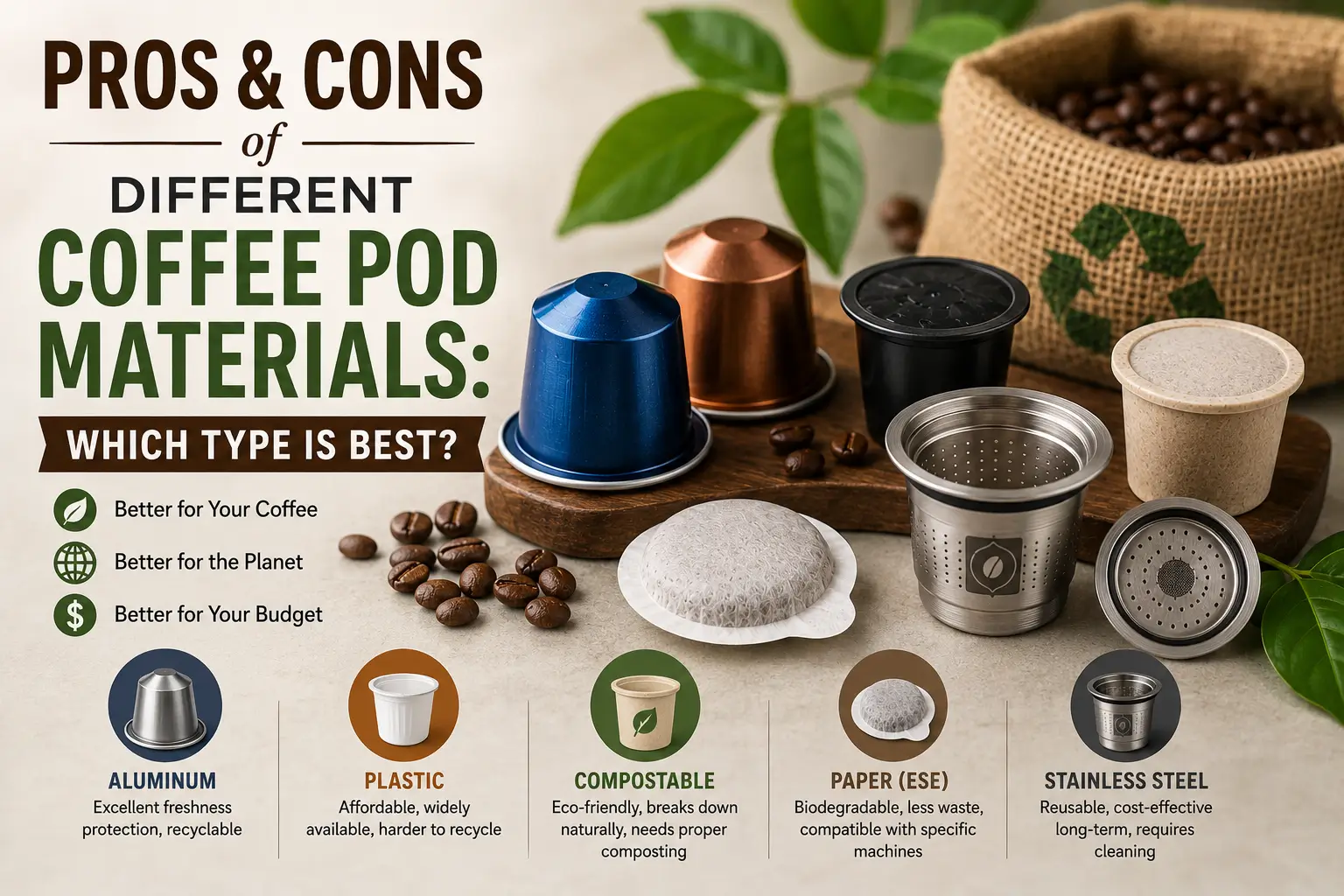

Aluminum vs Plastic vs Compostable Coffee Pods: Pros & Cons
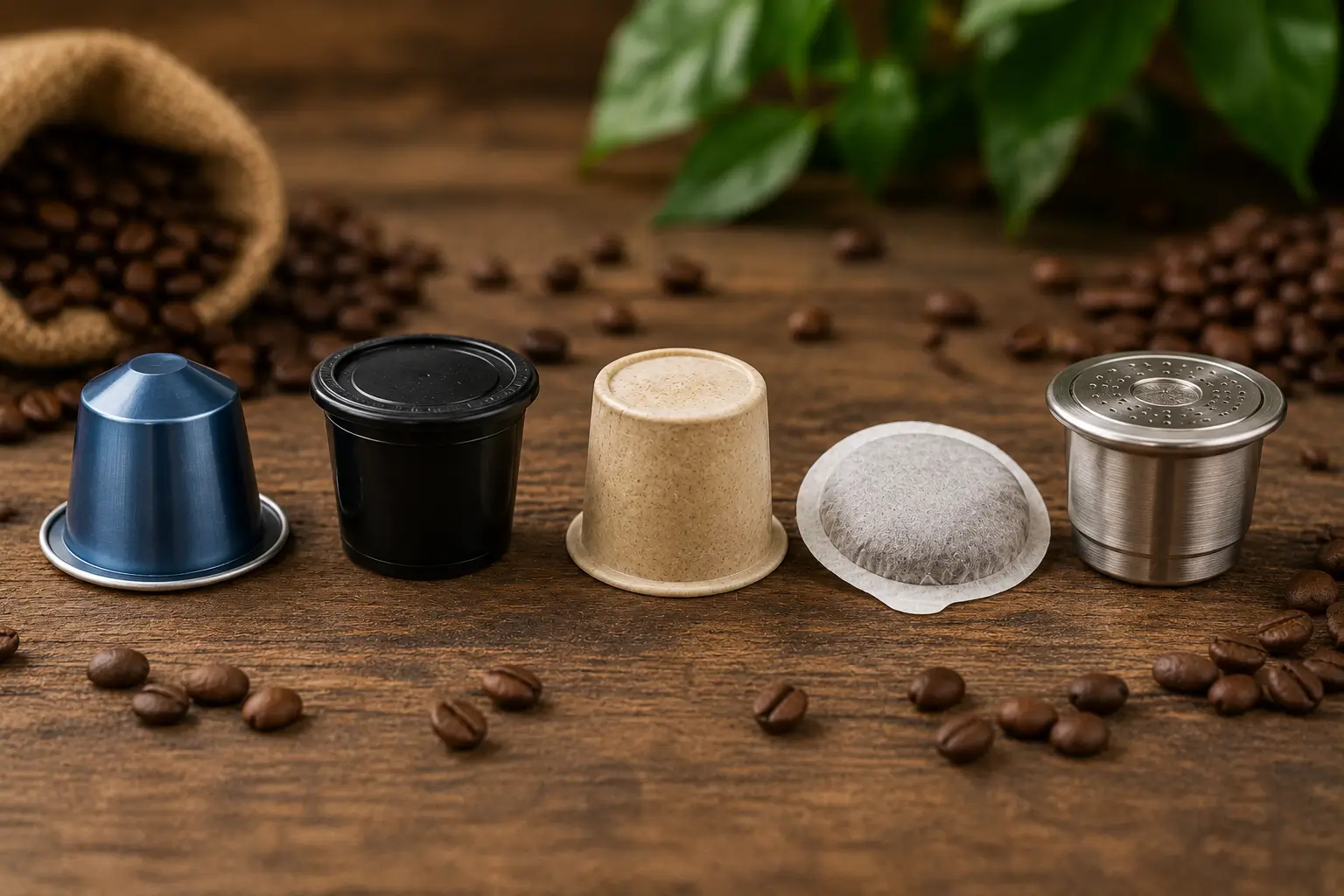
Coffee pods can look similar from the outside, but the material around ↗ the coffee changes how the pod is stored, brewed, recycled, composted, or reused. The main choices are aluminum, plastic, compostable materials, paper soft pods, and reusable metal pods.
There is no single material that is best for every coffee drinker. Aluminum can provide an excellent barrier against oxygen, moisture, and light. Polypropylene plastic can be lightweight and recyclable in some systems. Certified compostable pods can work well when you actually have access to the composting route they require. Reusable pods reduce the number of single-use capsules you buy, but they need cleaning and correct machine compatibility.
This guide compares the materials by freshness, disposal, convenience, cost, compatibility, and environmental trade-offs. It also answers practical questions that repeatedly appear in coffee communities: Can Nespresso pods go in normal recycling? Are K-Cups really recyclable? Does “compostable” mean home compostable? And are reusable pods always the greener choice?
Important Note
Material alone does not tell you the full environmental impact of a coffee pod. The result depends on the raw material, amount of material used, coffee production, outer packaging, brewing system, local recycling or composting infrastructure, and what actually happens to the used pod. A capsule labelled recyclable or compostable is only useful if the correct local disposal route is available.
Key Takeaways
- Aluminum: excellent protection from oxygen, moisture, and light, but it still needs a workable recycling route.
- Plastic: lightweight and common; genuine Keurig K-Cup pods use recyclable #5 polypropylene, but Keurig says they are not recycled in many communities.
- Compostable: check the certification. Commercial compostable and home compostable are not the same claim.
- Paper soft pods: use less rigid packaging, but compatibility is limited and the full product may include an outer wrapper.
- Reusable pods: can cut single-use pod waste, but require cleaning, refilling, and repeated use to deliver that benefit.
- Do not assume “recyclable,” “compostable,” or “reusable” automatically means lowest environmental impact.
- For most buyers, machine compatibility comes first.
Quick Answer
Choose coffee pod material by the job you need it to do. Aluminum is a strong choice for freshness protection. Plastic pods are common and can be recyclable when your local system accepts the exact plastic and pod format. Certified compostable pods make sense when you have access to the composting route stated on the package. Reusable pods can reduce single-use waste if your machine supports them and you are willing to refill and clean them.
Why Coffee Pod Material Matters
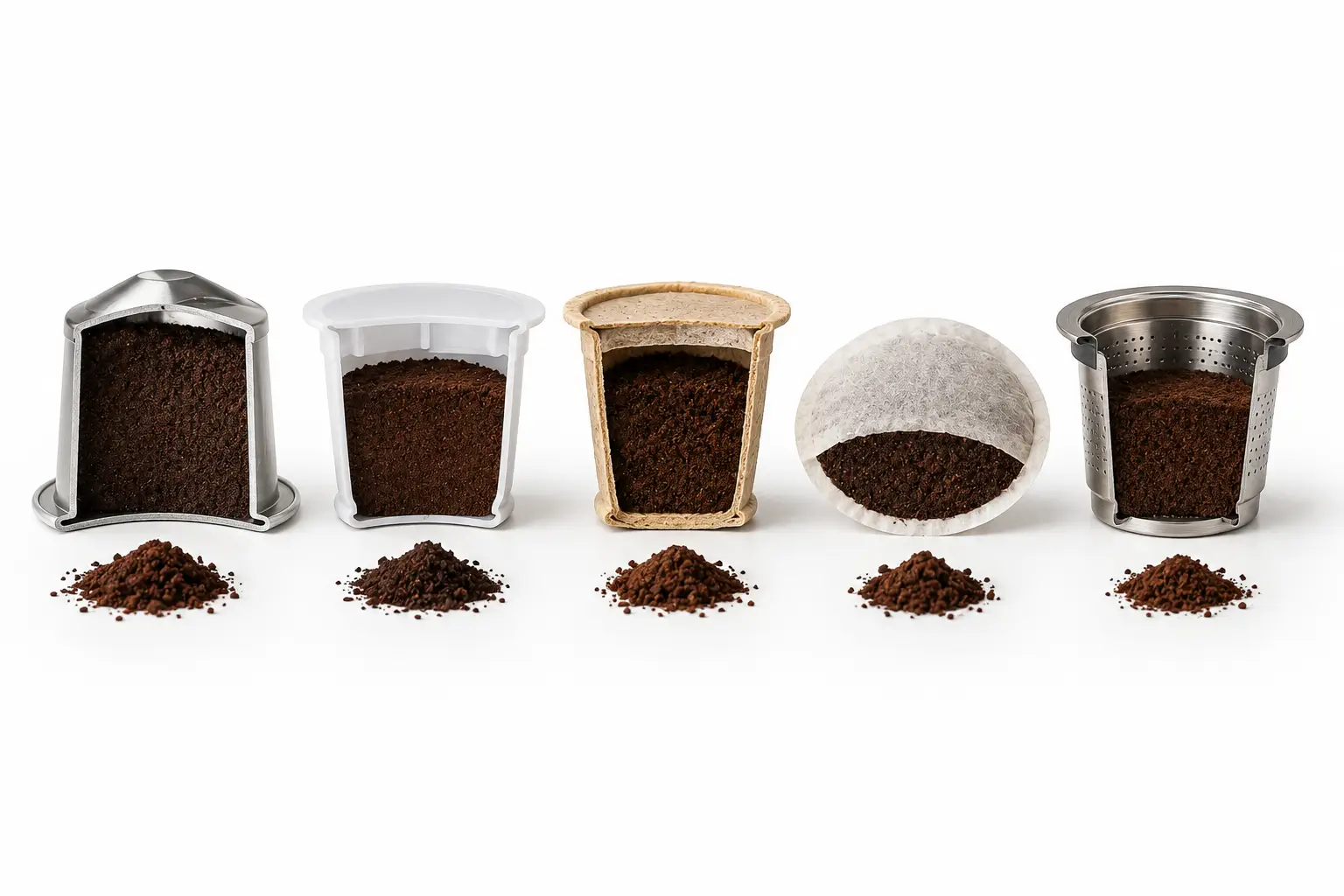
The shell, lid, filter, and outer wrapper work together as a packaging system. That system has to protect roasted coffee before brewing, survive storage and transport, fit the brewer correctly, and handle heat and pressure during extraction. After brewing, the same materials determine whether the pod can be recycled, composted, reused, or must be discarded.
Freshness
Barrier performance helps limit exposure to oxygen, moisture, and light before brewing.
Compatibility
Shape, rigidity, seal, and puncture design must match the brewer. Material alone does not guarantee compatibility.
Disposal
Recyclable or compostable claims depend on preparation rules and the facilities available where you live.
Convenience
Single-use pods reduce preparation time. Reusable pods trade some convenience for less single-use packaging.
Main Types of Coffee Pod Materials
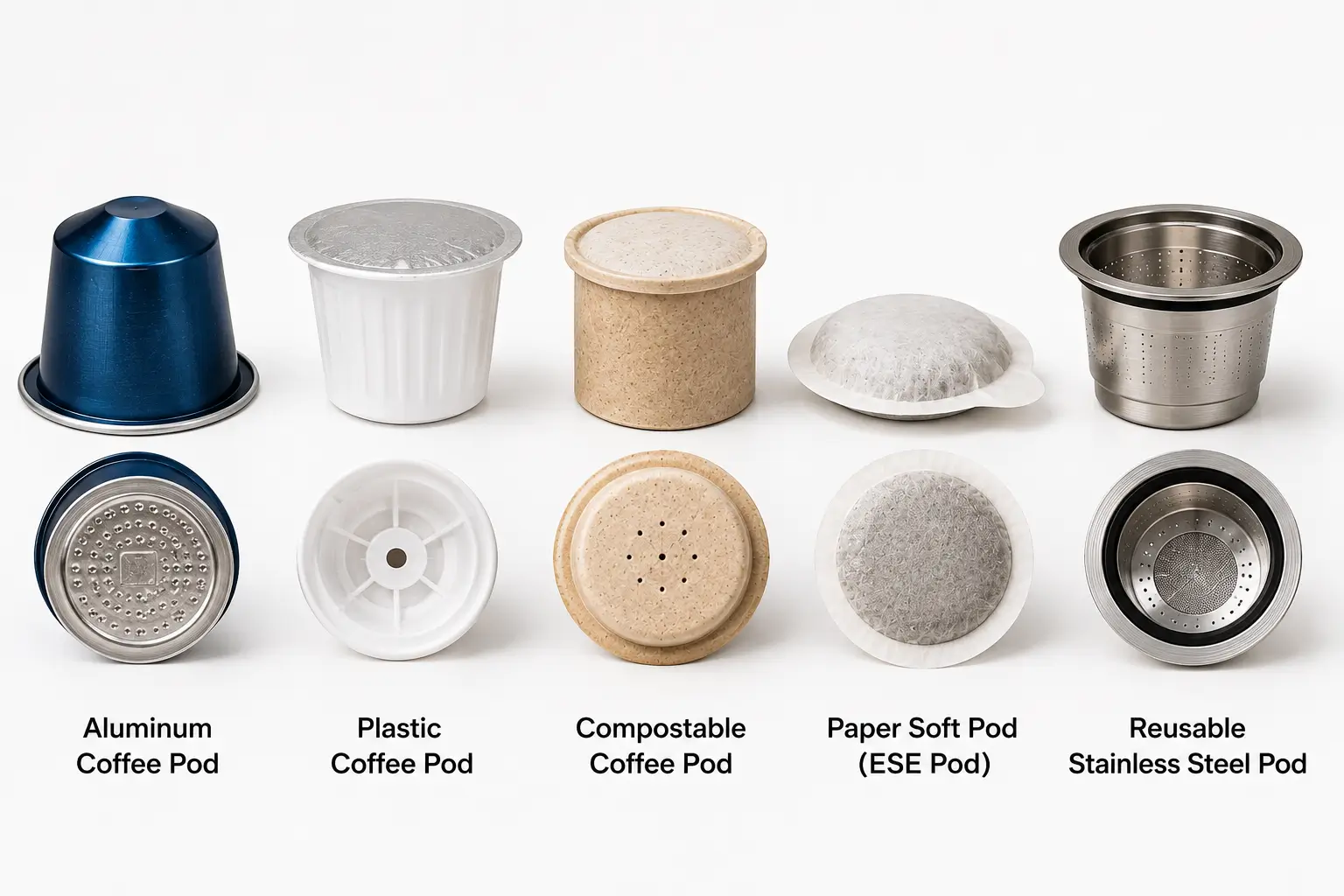
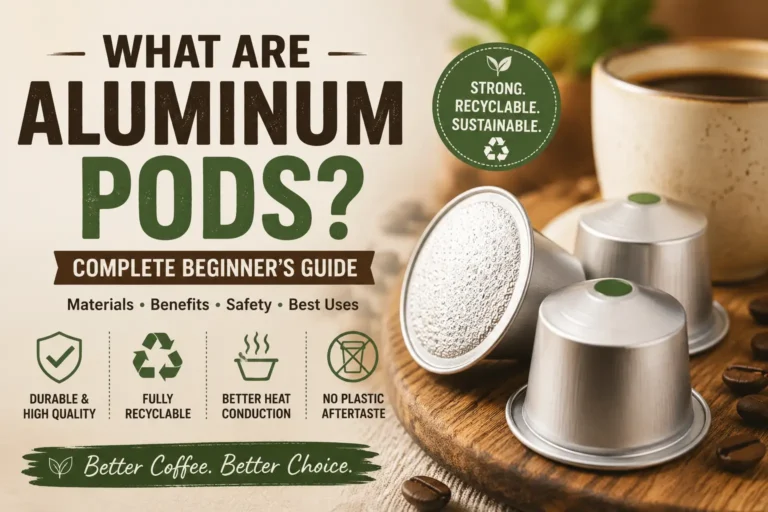
- Aluminum capsules — common in Nespresso and some compatible capsule ranges.
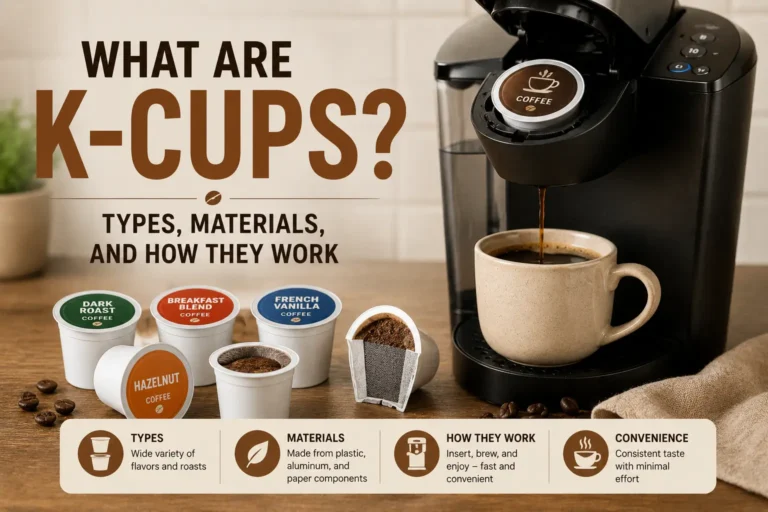
- Plastic pods — widely used in single-serve systems such as K-Cup-style products.
- Compostable capsules — made from certified compostable polymers, fibers, films, or combinations of materials.
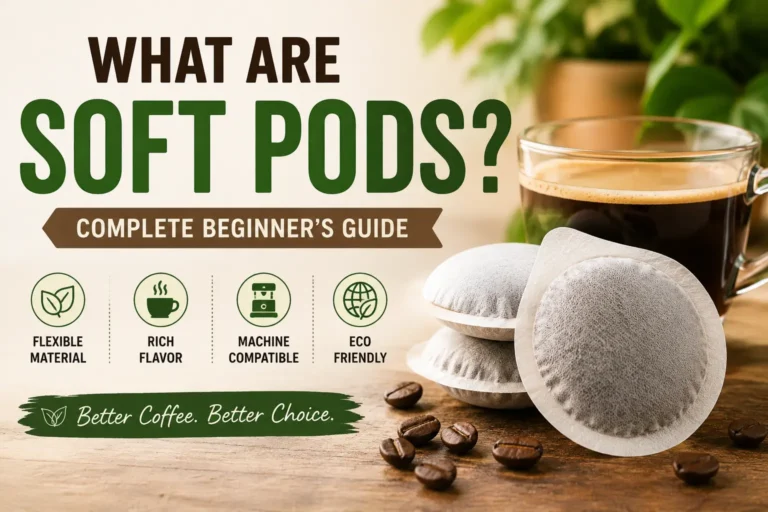
- Paper soft pods — filter-paper packs used in compatible soft-pod or ESE-style systems.
- Reusable pods — refillable capsules commonly made from stainless steel, plastic, or mixed materials.
The material name on its own is not enough to predict performance. A plastic capsule can use multiple barrier layers. A compostable capsule can come in a protective outer wrapper. A paper pod may also be individually wrapped. Judge the complete package, not only the visible shell.
Aluminum Coffee Pods: Pros and Cons
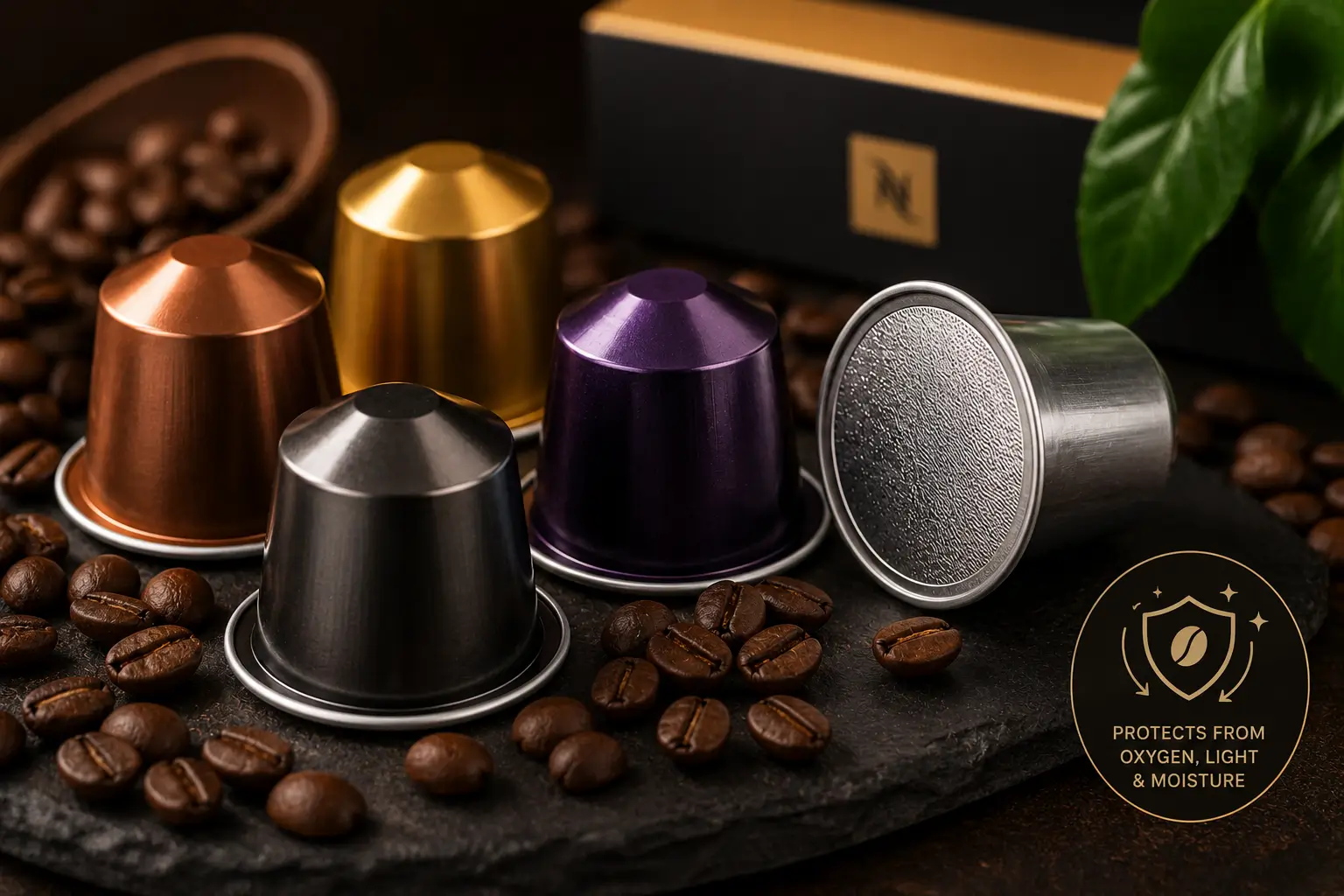
Aluminum is used because it can create a strong barrier around roasted coffee. Nespresso says its aluminum capsules protect coffee from oxygen, moisture, and light, helping preserve freshness and aroma.
Pros
- Excellent barrier protection when the capsule and seal are intact.
- Lightweight and strong for single-serve packaging.
- Aluminum can be recycled repeatedly through suitable recycling systems.
- Dedicated brand programs can make material recovery easier in some locations.
Cons
- Local curbside programs may not accept small used capsules.
- Collection or return programs can require extra storage and effort.
- Primary aluminum production is energy intensive, so recycled content and recovery matter.
- A recyclable material does not guarantee the used capsule will actually be recycled.
Community discussions show that the practical problem is often not whether aluminum can be recycled, but whether a local facility can sort a small coffee capsule or whether the user has access to a dedicated return program.
Plastic Coffee Pods: Pros and Cons
Plastic pods are common because they are lightweight, durable, and suitable for high-volume manufacturing. However, “plastic coffee pod” covers many constructions, so the exact resin and packaging design matter.
Keurig states that its genuine K-Cup pods are made from #5 polypropylene. It also says the pods are recyclable, but warns that they are not recycled in many communities. Keurig instructs users to peel the lid, empty the grounds, and check local acceptance.
Pros
- Lightweight and durable during transport and storage.
- Widely used, giving buyers many coffee choices.
- Some pod formats use recyclable polypropylene.
- Can be cost-effective at large manufacturing scale.
Cons
- Local recycling acceptance varies significantly.
- Small items can be difficult for some sorting systems to process.
- Single-use plastic that is not recovered becomes waste.
- Different plastics and multi-material constructions cannot be treated as one recycling category.
K-Cup Recycling Reality
“Recyclable” and “accepted in my curbside bin” are different questions. Keurig specifically tells users to check local recycling rules because facilities that accept polypropylene do not necessarily accept K-Cup pods.
Compostable Coffee Pods: Pros and Cons
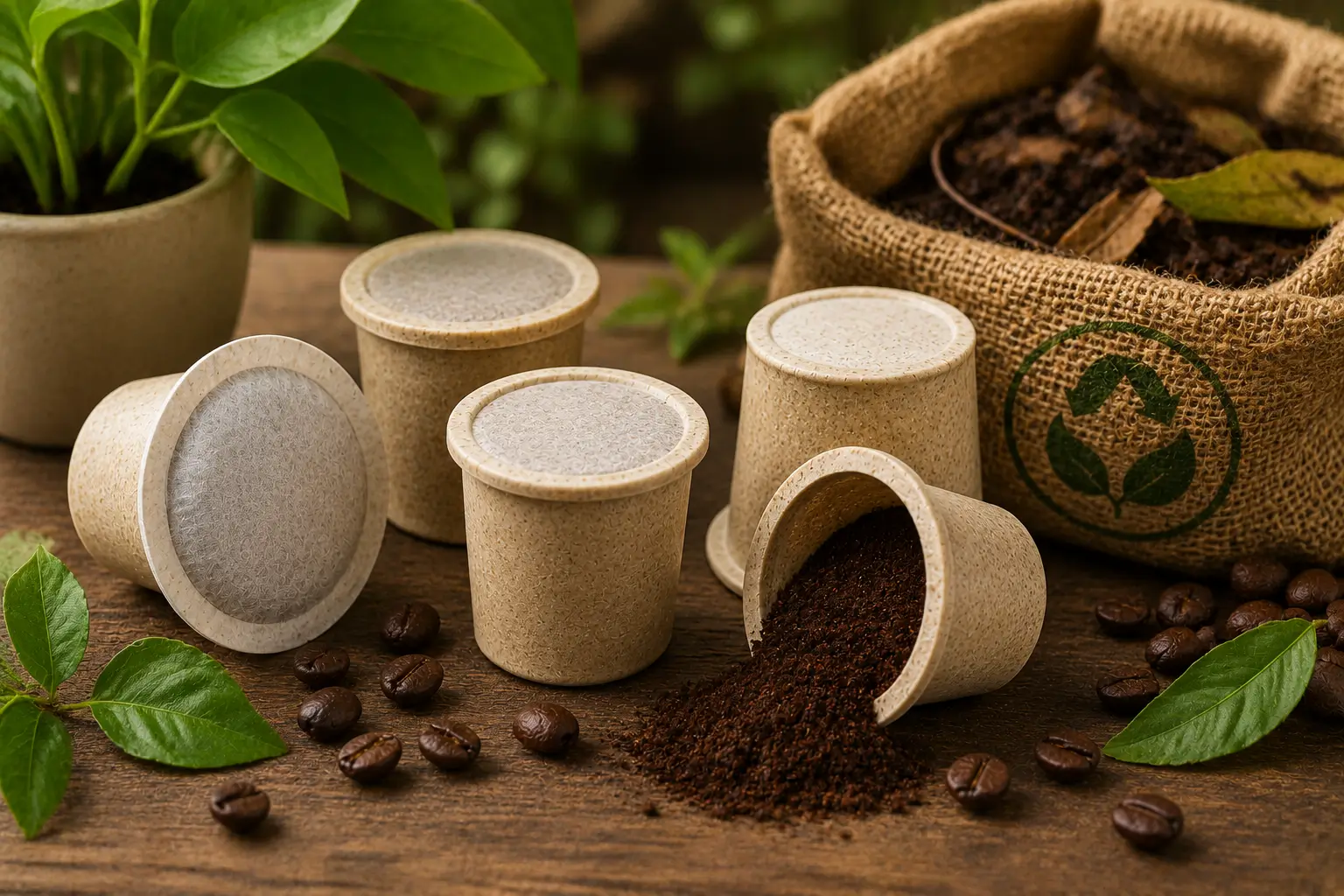
Compostable pods can use bio-based polymers, cellulose-based materials, filters, and compostable films. The key question is not simply whether a pod is “plant-based.” Ask what composting standard is the finished product certified to meet?
BPI distinguishes between Commercial Only certification and Commercial & Home certification. A commercially compostable capsule is not automatically suitable for a backyard compost bin.
Pros
- Offers an end-of-life route that does not depend on metal or plastic recycling when accepted by a composter.
- Can reduce reliance on conventional single-use fossil-based plastics.
- Certified home-compostable products can be useful where properly managed home composting is realistic.
- Spent grounds and certified pod materials may enter the same compost stream when the facility accepts them.
Cons
- Commercial compostability does not mean home compostability.
- Many communities do not accept compostable packaging in food-waste programs.
- Some designs need additional barrier packaging to protect coffee before brewing.
- Compatibility and puncture performance vary by product and machine.
A 2024 peer-reviewed life-cycle comparison found that the environmental ranking of aluminum, polypropylene, and compostable capsules changed with disposal and material-recovery assumptions. In its modeled current-disposal and 10-year scenarios, biocompostable options performed favorably, while polypropylene improved under a 100% raw-material recovery scenario. That is why this guide does not label one material as universally “greenest.”
Paper Soft Pods: Pros and Cons
Paper soft pods use filter paper rather than a rigid capsule shell. They are commonly associated with soft-pod and ESE-style brewing systems. They can use less rigid packaging than hard capsules, but they are not universally compatible with capsule machines.
Pros
- Less rigid pod material than many hard capsule systems.
- Simple, pre-measured brewing format.
- Paper components may be biodegradable or compostable when the product is designed and certified for that route.
Cons
- Works only with compatible soft-pod or ESE systems.
- Often offers a smaller product selection than K-Cup or Nespresso ecosystems.
- Freshness protection may depend heavily on an individual outer wrapper.
- Do not assume the whole product is home compostable just because the filter is paper.
For the dedicated format guide, see What Are Soft Coffee Pods? ↗
Reusable Stainless Steel Pods: Pros and Cons
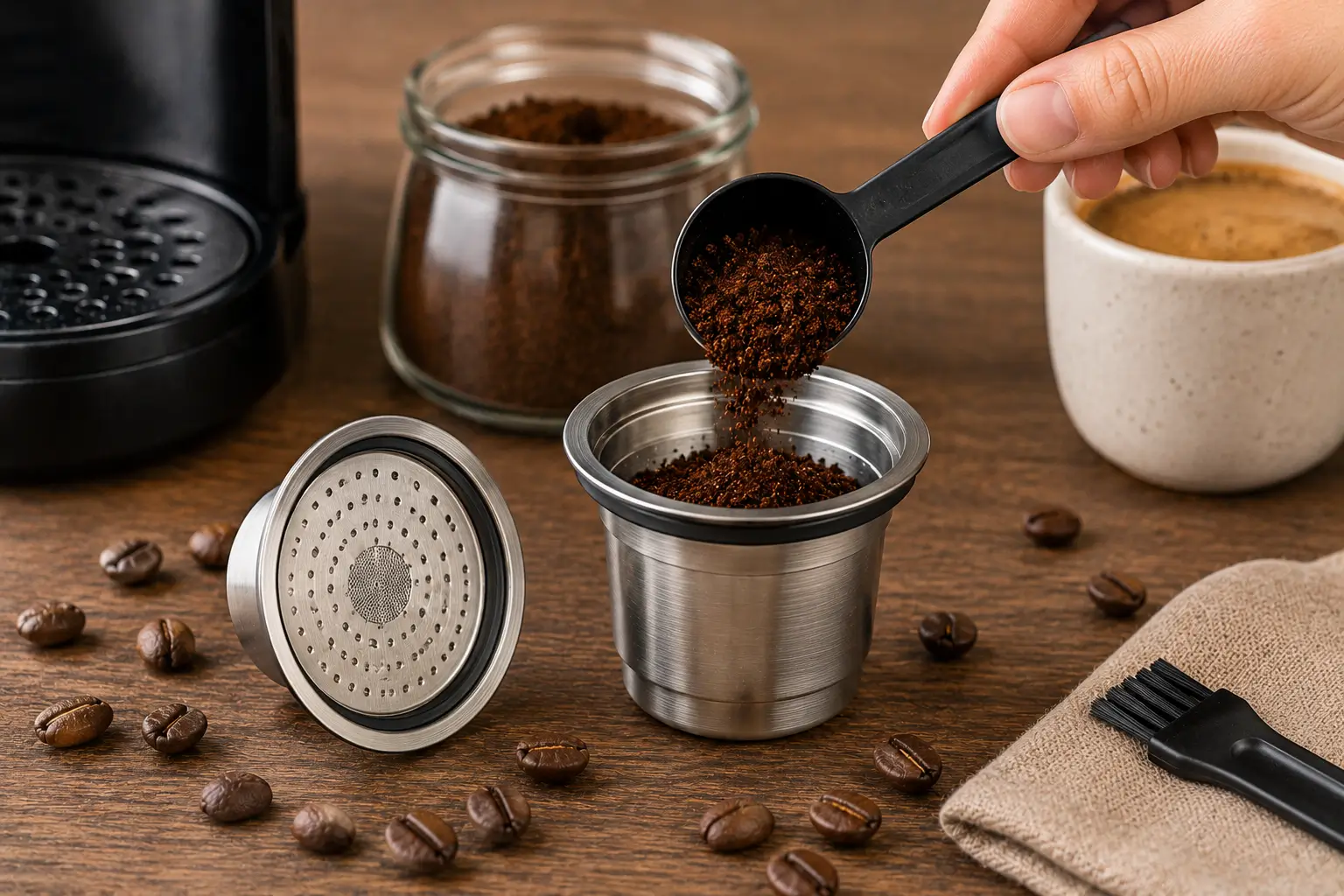
Reusable pods are filled with your own ground coffee and used repeatedly. Stainless steel versions are common, but reusable pods can also contain plastic or silicone parts. They reduce the number of single-use capsules purchased, but they change the workflow.
Pros
- Can replace many single-use capsules over time.
- Lets you choose your own ground coffee.
- Can reduce long-term packaging purchases.
- May lower cost per cup after the initial purchase.
Cons
- Needs filling, emptying, washing, and drying.
- Results can change with grind size, dose, and how the pod is filled.
- Compatibility is machine-specific.
- Environmental benefit depends on repeated use, cleaning habits, and supporting packaging.
Reusable Does Not Mean Universal
A reusable pod that fits one machine may not fit another. Check the brewer model and the reusable pod maker’s compatibility list before buying. Do not force an incompatible capsule into a machine.
Coffee Pod Material Comparison Table
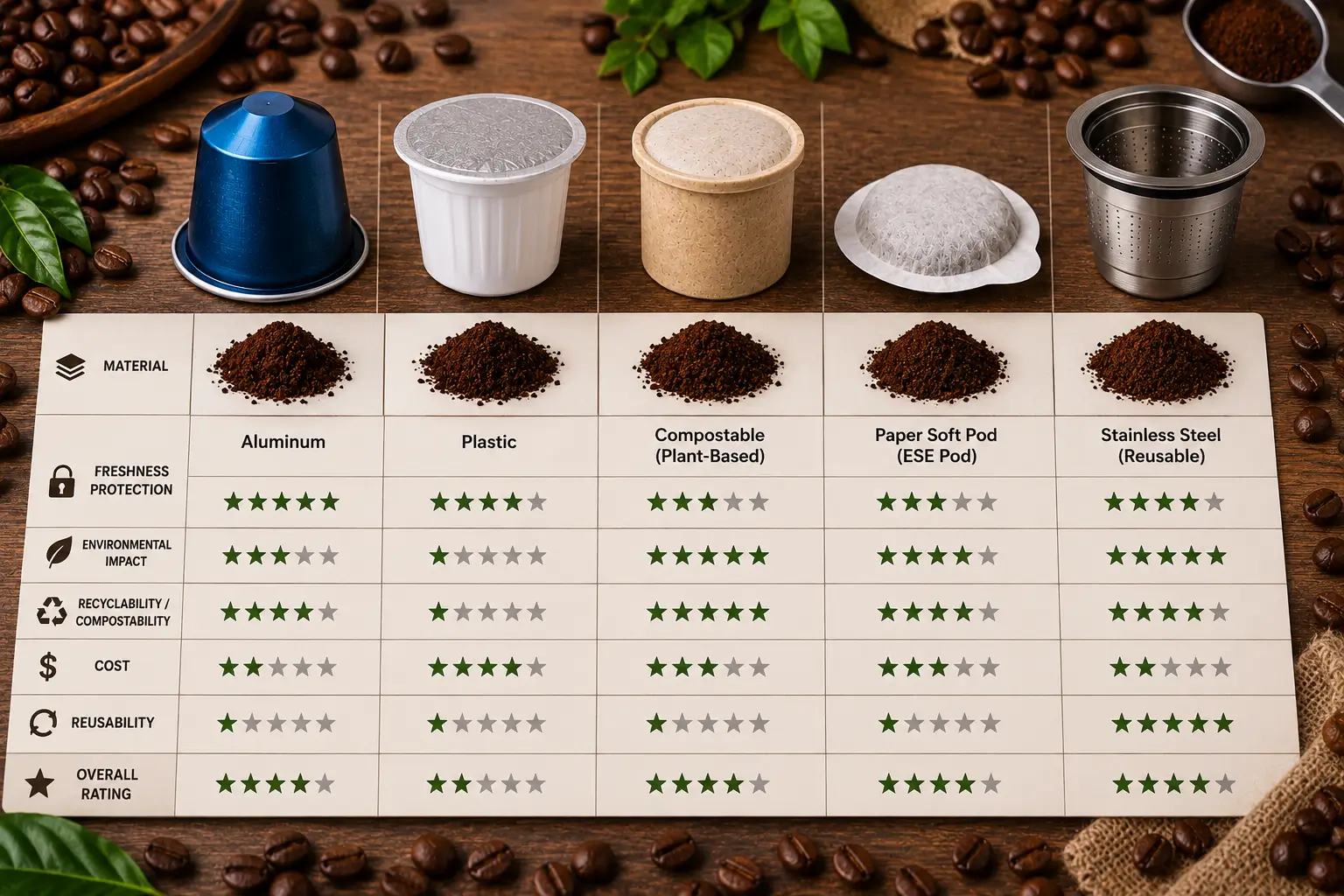
| Material | Freshness Protection | End-of-Life Route | Main Advantage | Main Limitation |
|---|---|---|---|---|
| Aluminum | Excellent barrier when sealed correctly | Recycling, often through local or brand programs | Strong protection from oxygen, moisture, and light | Small capsules may not be accepted in normal curbside systems |
| Plastic | Depends on resin, layers, and seal | Recycling where the exact pod/resin is accepted | Lightweight, common, wide product choice | Acceptance varies; many communities do not recycle small pods |
| Certified compostable | Depends on design and any outer barrier wrapper | Commercial or home composting, according to certification | Alternative end-of-life route | Correct composting infrastructure may not be available |
| Paper soft pod | Often depends on individual wrapping | Product-specific; paper alone does not prove compostability | Less rigid packaging and simple dosing | Limited machine compatibility |
| Reusable metal pod | Depends on how fresh your ground coffee is | Reuse many times; material disposal at end of life | Reduces single-use capsule purchases | Cleaning, filling, and brewer compatibility |
This table is a practical comparison, not a universal environmental ranking. The exact pod, outer packaging, local disposal route, and frequency of reuse can change the result.
Which Coffee Pod Material Protects Freshness Best?
If the question is strictly about blocking outside oxygen, moisture, and light, aluminum is a strong barrier material. Nespresso specifically cites those properties as a reason it uses aluminum.
That does not mean every plastic or compostable pod produces stale coffee. Manufacturers can use barrier layers, seals, inert-gas packing, and protective outer wrappers. The freshness of a finished product depends on the whole packaging system, not only the visible capsule shell.
For shelf-life questions, use the date and storage instructions on the exact product rather than a generic “aluminum lasts 18 months” or “compostable lasts six months” rule. Those broad ranges were removed from this update because manufacturers set shelf life based on the complete product and packaging. See How Long Do Coffee Pods Last? ↗
Which Coffee Pod Material Is Most Sustainable?
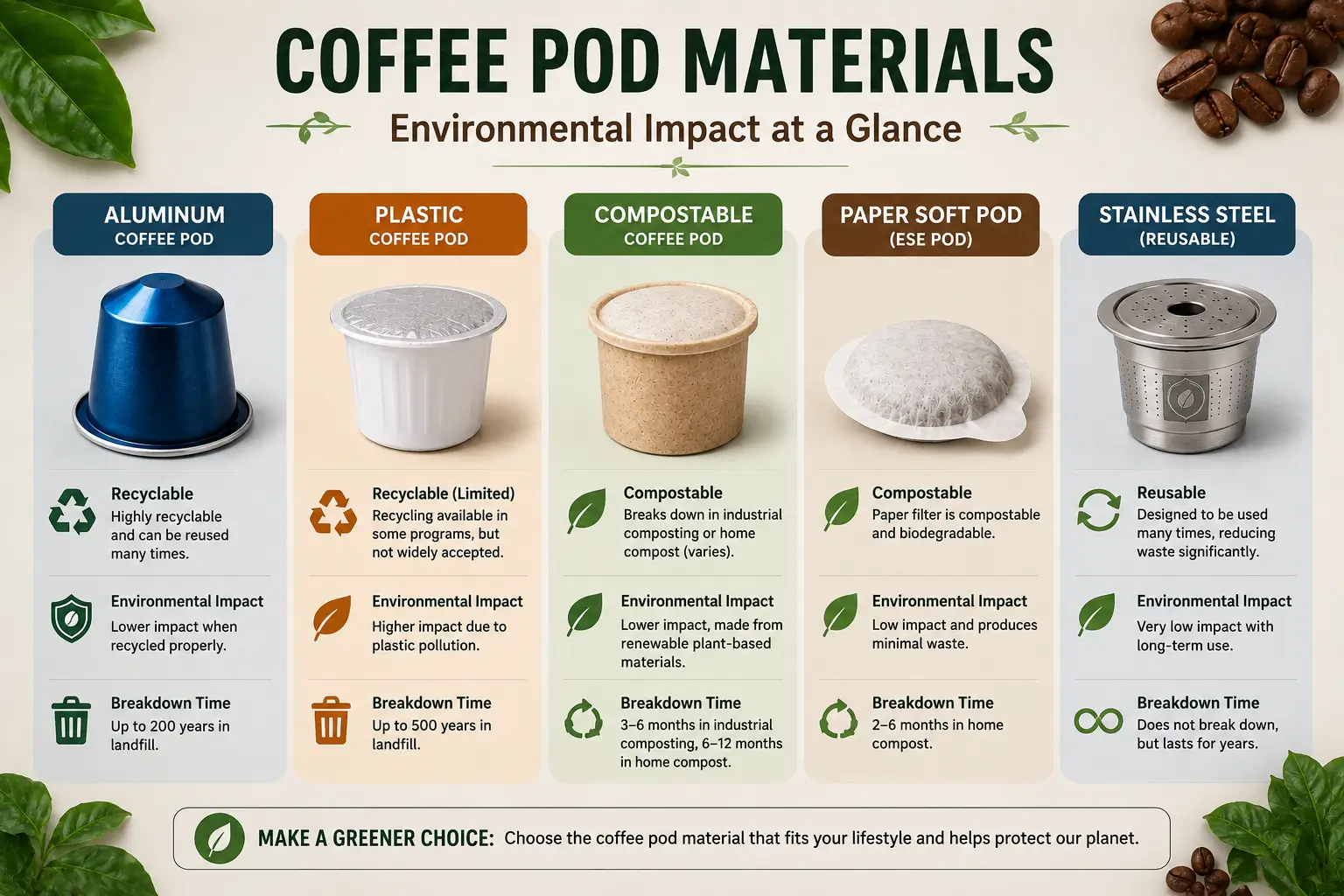
There is no evidence-based reason to label one pod material as the universal sustainability winner. Life-cycle results depend on assumptions about raw materials, coffee production, capsule manufacture, recycled content, transport, brewing, recovery rates, and disposal.
Aluminum
Strong recyclability potential, especially when capsules enter a dedicated recovery stream. Primary aluminum production is energy intensive, so recycled content matters.
Plastic
Lightweight, but environmental performance depends heavily on resin type and whether the pod is actually recovered.
Compostable
Can perform well in life-cycle comparisons, but the benefit depends on certification and access to the correct composting route.
Reusable
Can reduce single-use packaging, but the result depends on repeated use, cleaning, coffee dose, and supporting packaging.
For the broader sustainability topic, see Eco-Friendly Coffee Pods ↗. This article stays focused on material trade-offs so the two pages keep different search intent.
Recycling and Composting Challenges You Should Know
The most common practical questions in coffee communities are: Can this pod go in my normal bin? Do I need to empty it? Will a sorting facility accept something this small? Does compostable mean I can put it in my garden compost?
1. Small Pods Can Be a Sorting Problem
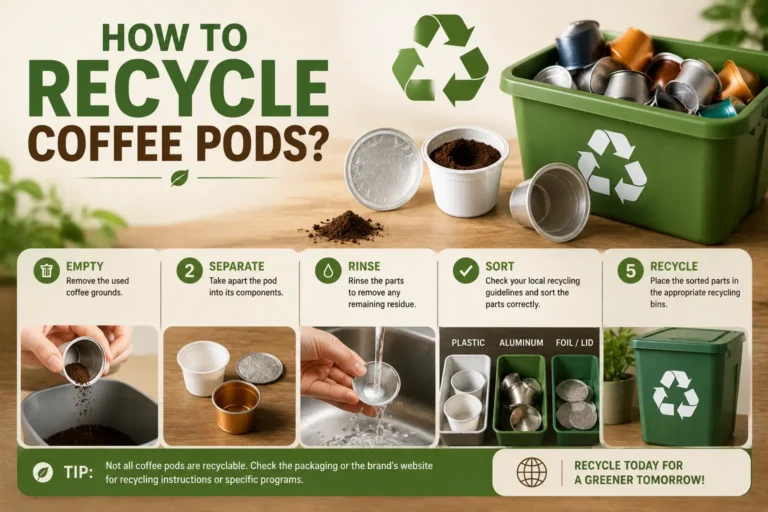
Even when the base material is recyclable, a local material-recovery facility may not accept small capsules. Keurig explicitly tells consumers to check local rules for K-Cup pods.
2. Preparation Rules Differ
Keurig instructs users to peel the lid and empty the grounds before recycling an accepted K-Cup. Dedicated capsule collection systems may separate materials at a specialist facility. Follow the program you actually use rather than applying one brand’s instructions to every pod.
3. “Compostable” Needs a Destination
BPI distinguishes commercial-only compostability from commercial-and-home certification. If your town does not accept certified compostable packaging, the label does not create a local composting route by itself.
4. Coffee Grounds Need a Plan Too
Used grounds can sometimes be composted separately. Dedicated capsule recycling programs may also separate grounds from the capsule material. Check the program instructions before opening or washing capsules yourself.
Best Disposal Question to Ask
Do not ask only, “Is this pod recyclable or compostable?” Ask: “Is this exact used pod accepted by the recycling or composting service I can actually use?”
Are Coffee Pod Materials Safe for Hot Water?
Coffee pods are food-contact packaging. In the U.S., food-contact substances must be authorized for their intended conditions of use. The FDA maintains food-contact substance authorizations and notifications. One FDA notification specifically covers a polymer component intended for single-use coffee capsules exposed to water up to 100°C for up to two minutes.
That does not mean every pod from every seller should be treated as identical. Buy capsules made for your machine from reputable manufacturers and follow the brewer’s instructions. Do not reuse a single-use pod unless it was designed for reuse.
What We Changed From the Older Version
The earlier article used broad claims such as fixed shelf-life ranges, “reusable = lowest environmental impact,” and simple recyclable/not-recyclable labels. Those statements were too absolute. This update replaces them with manufacturer instructions, certification distinctions, local-infrastructure caveats, and peer-reviewed life-cycle evidence.
Which Coffee Pod Material Should You Choose?
| Your Priority | Good Starting Choice | What to Verify First |
|---|---|---|
| Strong freshness barrier | Aluminum or another high-barrier sealed capsule | Machine compatibility and intact packaging |
| Easy local recycling | Whatever accepted material your local program specifically lists | Pod size, resin/material, preparation rules |
| Commercial composting | Certified commercial-compostable pod | Your local composter accepts the exact item |
| Home composting | Product specifically certified for home compostability | Home certification and composting instructions |
| Less single-use packaging | Compatible reusable pod | Brewer compatibility and willingness to clean/refill |
| Soft-pod brewing | Paper soft/ESE pod | Your machine supports that pod format |
The best material is the option that works with your brewer, keeps the coffee protected, and has an end-of-life route you can realistically follow.
Frequently Asked Questions
Aluminum offers excellent barrier protection and can be recycled repeatedly. Plastic pods can be lightweight, affordable, and recyclable in some systems. The better option depends on your brewer, local recycling access, and the exact product.
It depends on your location. Nespresso offers dedicated recycling options in many markets, while some local systems also accept capsules. Check Nespresso’s current instructions and your local recycling provider before placing used capsules in curbside recycling.
Keurig says its genuine K-Cup pods are made from recyclable #5 polypropylene, but also warns that they are not recycled in many communities. Peel the lid, empty the grounds, and confirm local acceptance.
Certified compostable pods are designed for specific composting conditions, but commercial and home compostability are different. Check the certification and whether your composting service accepts the exact pod.
No. A product may be certified only for commercial composting. Look for an explicit home-compostability certification before putting it in a home compost system.
Aluminum provides an excellent barrier against oxygen, moisture, and light. However, freshness also depends on the lid, seal, outer packaging, storage, and product-specific best-before guidance.
Not automatically. Reusable pods reduce single-use capsule purchases, but the overall result depends on repeated use, washing, the coffee packaging you buy, and the brewing system.
The paper component may biodegrade, but that does not prove the whole pod and wrapper are certified for composting. Check the product’s material and disposal instructions.
Reputable manufacturers use materials intended for food contact and the brewing conditions of their system. In the U.S., food-contact substances must be authorized for their intended use. Use compatible products and follow manufacturer instructions.
There is no universal winner. Choose according to brewer compatibility, freshness needs, and a recycling, composting, or reuse route that is realistically available to you.
Final Thoughts
Coffee pod materials involve trade-offs. Aluminum is excellent at protecting coffee and has strong recycling potential when it reaches the right system. Plastic is lightweight and common, but actual recycling access varies. Compostable pods need the right certification and composting route. Paper soft pods use a simpler format but need a compatible machine. Reusable pods reduce single-use purchases when they are used repeatedly and cleaned properly.
The most practical choice is the material that works with your brewer, protects the coffee, and has an end-of-life route you can really use. That is more useful than choosing a pod only because the package says “recyclable,” “compostable,” or “eco-friendly.”