

Decaf Coffee Pods: Caffeine, Methods & Buying Guide

Decaf coffee pods are single-serve coffees made from beans with most of their caffeine removed before roasting and packaging. They are useful when you want coffee flavor ↗ with much less caffeine, but decaf does not mean caffeine-free.
The amount left depends on the coffee, capsule size and brand. Keurig says its decaf coffee generally contains about 2–4 mg per 8 oz cup. Nespresso regional guidance commonly places Original decaf around 2–4 mg per cup, while some Vertuo decaf servings are around 4–12 mg.
This guide explains how decaf is made, what the main processing methods mean, how decaf compares with regular and half-caff coffee, and how to choose the right K-Cup, Nespresso or other pod format.
Important Note
Decaf contains much less caffeine, but it can still contain a small amount. If you must follow a strict caffeine limit for pregnancy, medication, a medical condition or another reason, count all caffeine sources and follow your healthcare professional’s advice.
Key Takeaways
- Decaf is not caffeine-free. It contains much less caffeine than regular coffee.
- Keurig lists decaf coffee around 2–4 mg caffeine per 8 oz.
- Nespresso decaf varies by market and system; Original is commonly around 2–4 mg, while Vertuo decaf can be around 4–12 mg.
- Main decaffeination approaches use water, carbon dioxide, methylene chloride or ethyl acetate to separate caffeine from green coffee beans.
- In the U.S., methylene chloride is currently permitted for coffee decaffeination with a maximum residue of 10 ppm in decaffeinated roasted coffee; an FDA petition seeking removal of this use remains under review.
- Decaf can be a better evening option, but very caffeine-sensitive people may still notice the small residual amount.
- Switching abruptly from several regular coffees to decaf can trigger caffeine withdrawal in a regular caffeine user.
- Decaf and low-acid coffee are different: one describes caffeine reduction; the other describes acidity or taste.
Quick Answer
Decaf coffee pods are regular coffee beans processed to remove most of their caffeine before the beans are roasted and packed into pods. Most decaf still contains a small amount of caffeine. Choose decaf when you want much less caffeine, then check the roast, pod compatibility, decaffeination method and serving size separately.
What Are Decaf Coffee Pods?
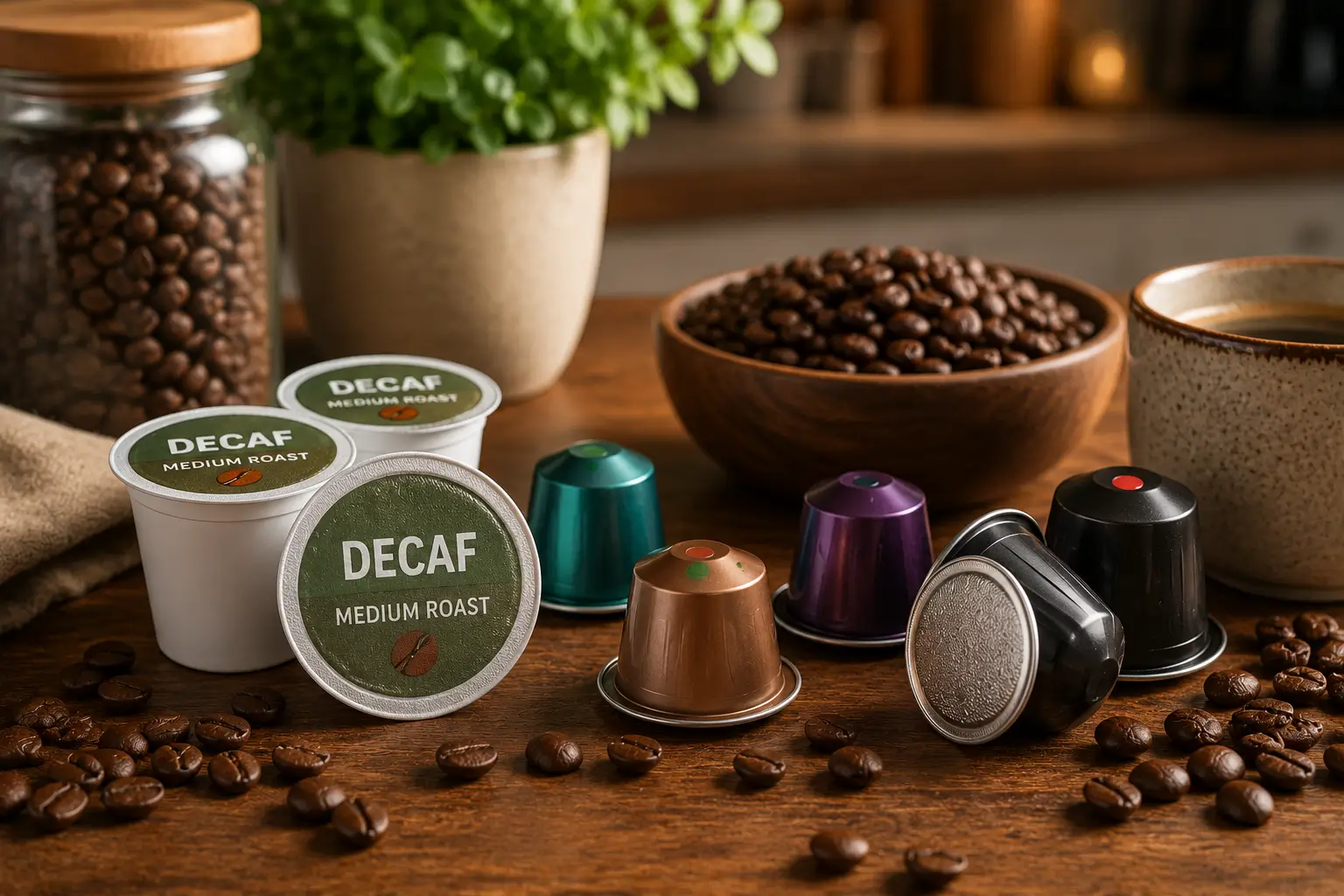
Decaf coffee pods are single-serve portions made from decaffeinated coffee beans. The caffeine-removal step normally happens while the beans are still green, before roasting.
You can find decaf in several single-serve formats:
- K-Cup-compatible coffee pods.
- Nespresso Original decaf capsules.
- Nespresso Vertuo decaf capsules.
- E.S.E. and other espresso-style pods.
- Soft coffee pods.
- Ground decaf coffee for compatible reusable pods.
The machine format and the caffeine level are separate questions. A pod can be decaf but still incompatible with your brewer.
How Much Caffeine Is in Decaf Coffee Pods?
Decaf still contains caffeine. FDA consumer guidance explicitly notes that decaffeinated coffee and tea contain less caffeine than regular versions but are not caffeine-free.
| Pod / Drink Type | Current Caffeine Guidance | What It Means |
|---|---|---|
| Keurig decaf coffee | About 2–4 mg per 8 oz | Much lower than Keurig’s regular coffee range |
| Keurig regular coffee | About 75–150 mg per 8 oz | A much larger caffeine dose |
| Nespresso Original decaf | Common regional guidance: about 2–4 mg per cup | Very low, but not zero |
| Nespresso Vertuo decaf | Some regional guidance: about 4–12 mg per cup | Can contain more residual caffeine because servings/capsules differ |
| Generic brewed decaf | FDA educational guidance gives a broad example of roughly 2–15 mg per 8 oz | Brand and serving size matter |
If caffeine amount is your main question, see Caffeine in Coffee Pods ↗ and Coffee Pod Caffeine Comparison ↗.
“Decaf” and “Caffeine-Free” Are Not the Same
Decaf starts with coffee that naturally contains caffeine, then removes most of it. A naturally caffeine-free drink, such as some herbal teas, did not contain caffeine to begin with.
How Is Decaf Coffee Made?
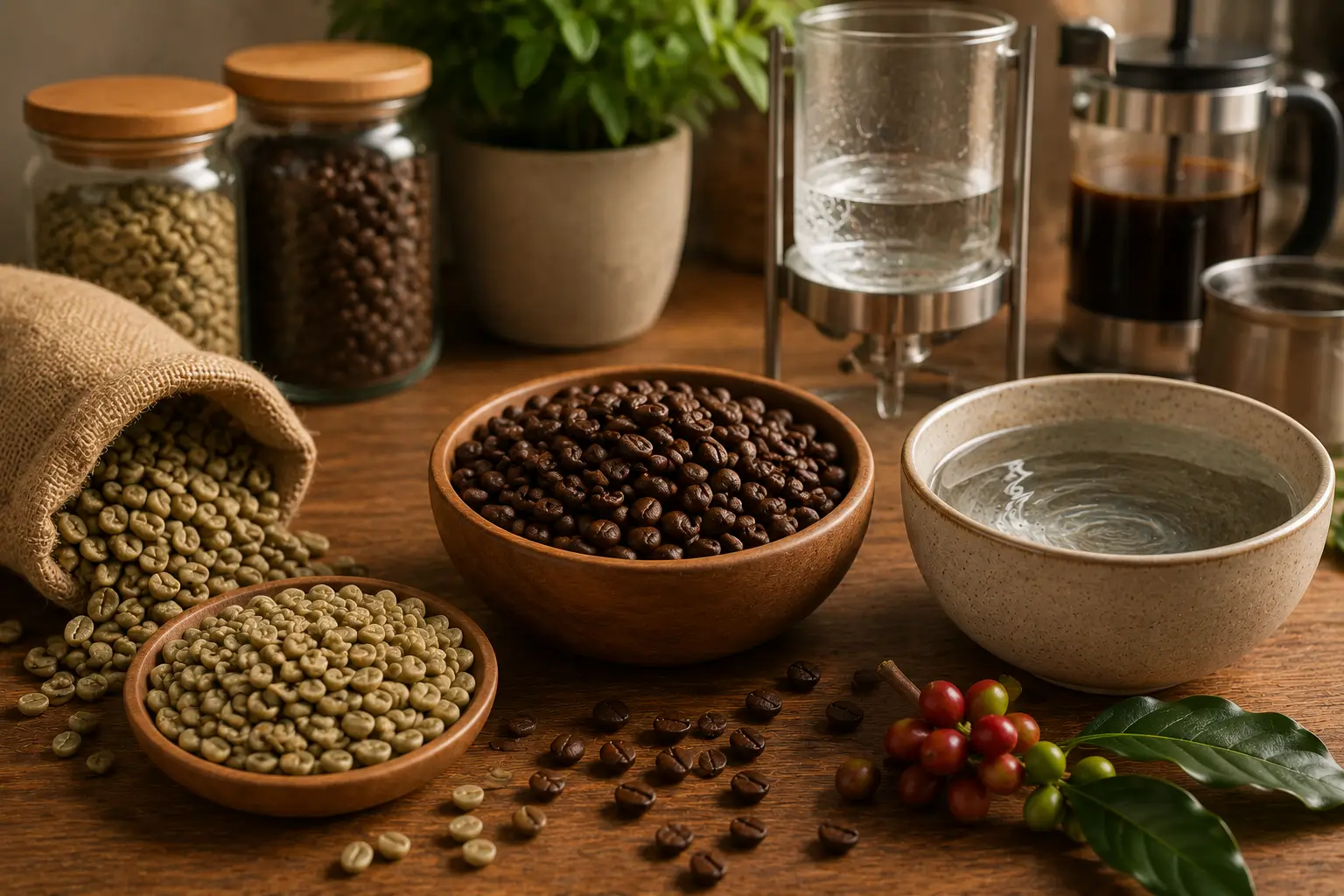
Commercial decaffeination removes caffeine from green coffee beans before roasting. The challenge is removing caffeine while keeping as much of the coffee’s flavor chemistry as practical.
The Specialty Coffee Association describes the main principle simply: caffeine must be dissolved or selectively removed from the bean. Different processes use water, carbon dioxide or other solvents, and some use activated carbon to capture caffeine after it moves into water.
Main Decaffeination Methods Compared
| Method | How It Works | What Shoppers Should Know |
|---|---|---|
| Water-based process | Water extracts soluble compounds; caffeine is selectively removed, often with activated carbon, while flavor-rich liquid is reused | Often marketed as water process; exact branded process can differ |
| Supercritical CO₂ | Highly pressurized carbon dioxide selectively extracts caffeine | No methylene chloride is used; process is commonly used at industrial scale |
| Methylene chloride | A solvent selectively dissolves caffeine from green beans | Still permitted under current U.S. food regulation with a residue limit |
| Ethyl acetate | Ethyl acetate is used as the caffeine-selective solvent | Sometimes marketed as “sugarcane” or “natural” process depending on source and brand |
All methods can produce good or poor-tasting decaf. Bean quality, roasting and freshness still matter after the decaffeination step.
What About Methylene Chloride in Decaf Coffee?
This topic deserves precise wording because regulation is changing slowly and public discussion is often more dramatic than the current legal status.
As of October 23, 2026, U.S. regulation under 21 CFR §173.255 still allows methylene chloride to be used to extract caffeine from green coffee beans. The permitted residue in decaffeinated roasted coffee and decaffeinated soluble coffee extract is capped at 10 parts per million (0.001%).
The FDA also has a food-additive petition under review seeking to remove several solvent uses, including methylene chloride. The comment period was reopened in 2026. The petition being under review does not mean the existing coffee regulation has already been removed.
If You Prefer to Avoid This Process
Choose a product that clearly states a water-based or CO₂ decaffeination method. Do not assume every decaf pod uses the same process, and do not assume an unlabeled pod is automatically water-processed.
Why Do People Choose Decaf Coffee Pods?
Much Less Caffeine
Useful when you enjoy coffee but want to reduce total caffeine.
Evening Flexibility
A decaf pod can preserve the coffee routine with a much smaller caffeine dose.
Same Brewing Convenience
K-Cup and capsule systems brew decaf with the same basic workflow as regular pods.
Multiple Roast Choices
Decaf is available in light, medium, dark and espresso-style profiles.
Decaf is a caffeine-management tool. It is not automatically a medical treatment or a nutritionally superior form of coffee.
Is Decaf Coffee Better at Night?

For many people, yes. The main reason is the much lower caffeine dose.
Regular caffeine can delay sleep, reduce total sleep time and affect sleep quality. Replacing a late regular pod with decaf substantially reduces that stimulant exposure.
But decaf is not zero caffeine. Someone who is extremely caffeine-sensitive, drinks several decaf servings, or uses a larger decaf capsule may still want to track how late coffee affects sleep.
See Can Coffee Pods Affect Sleep?.
Can Switching to Decaf Cause a Headache?
Decaf itself is not the usual problem. The problem can be a sudden drop in caffeine.
If you regularly drink several caffeinated pods and switch all of them to decaf overnight, your caffeine intake may fall sharply. Caffeine withdrawal can begin around 12–24 hours after a large reduction, often peaks around 20–51 hours, and commonly resolves within 2–9 days.
A Gradual Switch Can Be Easier
If you are a regular high-caffeine user and do not need to stop immediately for medical reasons, replacing one serving at a time with decaf or half-caff can make the caffeine reduction less abrupt.
See Can Coffee Pods Cause Headaches? ↗.
Is Decaf Better for Sensitive Stomachs or Reflux?

It may be easier for some people because it contains much less caffeine. But decaf is not the same as low-acid coffee, and it does not guarantee relief from heartburn or GERD.
Decaf still contains coffee acids and other coffee compounds. Individual triggers differ. If caffeine seems to be the main trigger, decaf is a logical test. If acidity, serving size, high-fat creamer or timing matters more, changing only the caffeine may not solve the problem.
| Label | Main Meaning | Does It Guarantee Reflux Relief? |
|---|---|---|
| Decaf | Most caffeine removed | No |
| Half-caff | Less caffeine than regular | No |
| Low acid | Lower acidity or smoother-acidity claim | No |
| Dark roast | Roast/flavor profile | No |
Does Decaf Coffee Still Contain Antioxidants and Other Coffee Compounds?
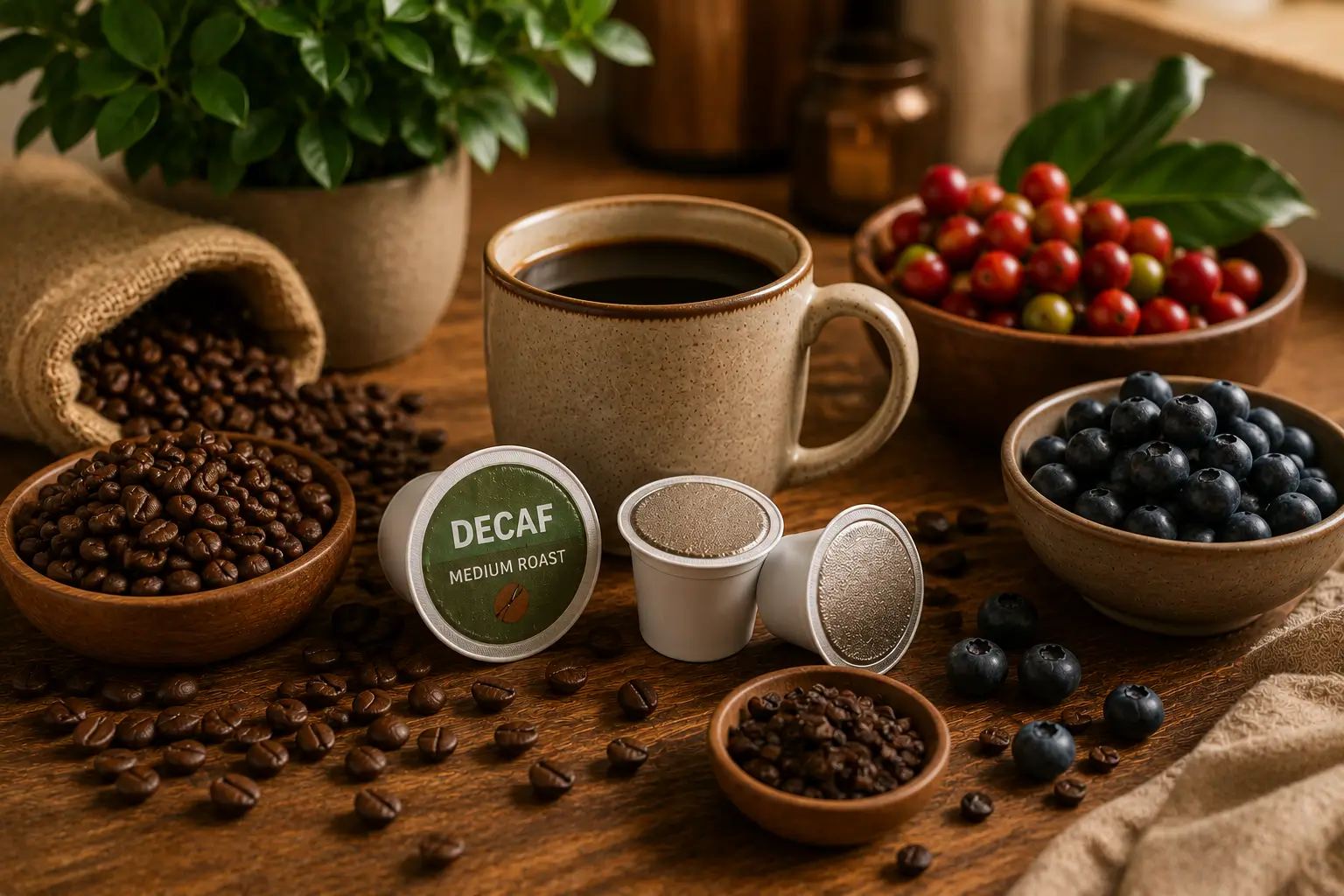
Yes. Removing caffeine does not remove every other coffee compound. Decaf still contains chlorogenic acids, polyphenols and other non-caffeine compounds found in coffee.
However, processing can change their levels. Research comparing regular and decaffeinated coffees shows that decaffeination can alter chlorogenic acids, trigonelline and flavor compounds, and the direction or size of the change depends on the process, bean and roast.
Avoid the “Same Antioxidants” Shortcut
It is fair to say decaf still contains coffee polyphenols. It is not precise to say every decaf pod has exactly the same antioxidant profile as its regular version.
Decaf vs Regular vs Half-Caff Coffee Pods
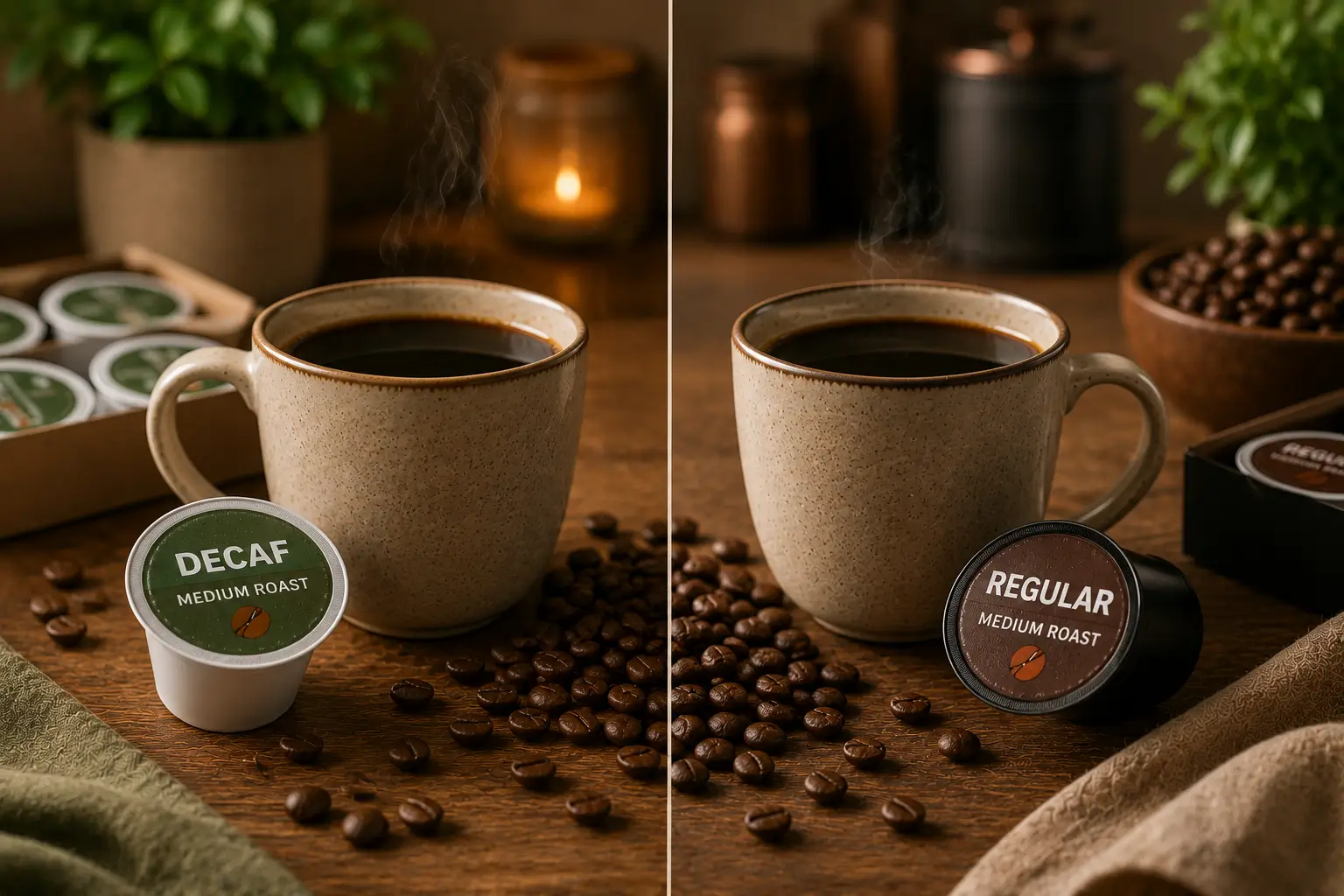
| Feature | Decaf | Half-Caff | Regular |
|---|---|---|---|
| Caffeine | Very low, but not zero | Reduced; exact amount varies | Normal product amount |
| Best for | Major caffeine reduction | Gradual reduction or middle ground | People who want full caffeine |
| Evening use | Usually the lower-caffeine choice | Still contains meaningful caffeine | More likely to affect sleep when taken late |
| Acidity | Varies | Varies | Varies |
| Coffee compounds | Still present; processing can change levels | Present | Present |
Decaf K-Cups vs Nespresso Decaf Capsules
Compatibility comes first. A decaf pod only helps if it fits your brewer.
| System | Decaf Caffeine Context | Buying Check |
|---|---|---|
| Keurig / K-Cup | General Keurig guidance: about 2–4 mg per 8 oz | Confirm K-Cup compatibility and serving size |
| Nespresso Original | Common regional range: about 2–4 mg | Original-compatible only; not Vertuo |
| Nespresso Vertuo | Some regional guidance: about 4–12 mg | Vertuo capsule required; serving sizes vary |
| Reusable pod | Depends on the decaf ground coffee you add | Check reusable pod compatibility with the brewer |
Nespresso states that its decaffeinated coffee uses a water-based process in several regional FAQs. Exact varieties and caffeine guidance can differ by market.
For system differences, see Nespresso vs Keurig ↗.
Does Decaf Coffee Taste Weaker?
Not automatically. Caffeine level and coffee strength are different things.
Decaf flavor depends on:
- Bean quality and origin.
- Decaffeination process.
- Roast level.
- Freshness.
- Amount of coffee in the pod.
- Brewing volume and extraction.
A dark-roast decaf pod can taste stronger than a light-roast caffeinated pod even though it has far less caffeine.
See Coffee Pod Flavor Intensity ↗.
What Decaf Roast Options Are Available?
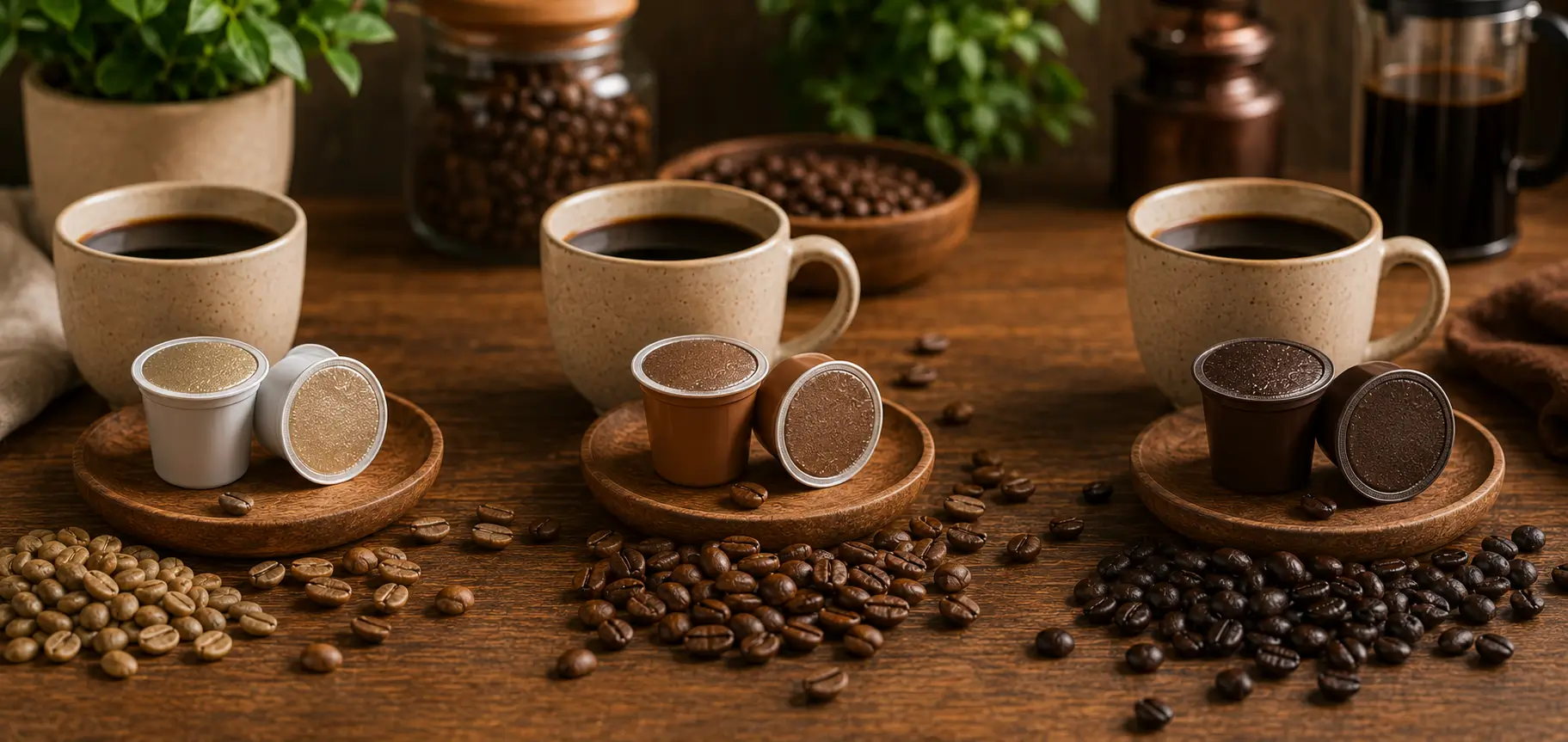
Light Roast Decaf
Can emphasize brighter, fruitier or floral notes. Availability is usually smaller than medium/dark decaf.
Medium Roast Decaf
Often balances sweetness, roast flavor and body. A common all-purpose decaf style.
Dark Roast Decaf
Usually offers deeper roasted, cocoa, smoky or bitter notes without restoring the removed caffeine.
Single-Origin Decaf
Focuses on one origin, but processing and roast still strongly shape the final flavor.
How to Choose Decaf Coffee Pods
- Start with compatibility: K-Cup, Original and Vertuo capsules are not interchangeable.
- Check the decaf caffeine information: do not assume every product has exactly the same residual caffeine.
- Look for the decaffeination method if it matters to you: water, CO₂, methylene chloride or ethyl acetate.
- Choose roast for taste: light, medium and dark describe flavor more than caffeine.
- Check ingredients: flavored or specialty pods may contain more than plain coffee.
- Consider serving size: larger capsules may contain more residual caffeine than small espresso capsules.
- Compare cost per cup: decaf price can differ from the brand’s regular line.
For price comparison, see Coffee Pods Cost Per Cup ↗.
Are Decaf Coffee Pods Healthy?
Plain decaf coffee can fit into a normal diet for many adults. Its main difference from regular coffee is the much lower caffeine level.
Decaf still contains coffee polyphenols and other compounds, but its health effects should not be reduced to one “antioxidant” claim. Overall health also depends on what you add to the drink, how many servings you have, your medical context and the rest of your diet.
Sweetened latte-style or flavored decaf products can have a very different nutrition profile from plain black decaf.
See Coffee Pods Calories & Nutrition ↗ and Health Benefits & Risks of Coffee Pods ↗.
Frequently Asked Questions
Yes. Decaf coffee contains much less caffeine than regular coffee, but it is not normally caffeine-free.
Keurig says its decaf coffees generally contain about 2–4 mg of caffeine per 8 oz cup.
Nespresso regional guidance commonly places Original decaf around 2–4 mg per cup. Some Vertuo decaf guidance is around 4–12 mg. Exact figures can vary by market and capsule.
No. “Decaf” means most caffeine has been removed. It does not mean zero caffeine.
Commercial methods use water, supercritical carbon dioxide, methylene chloride or ethyl acetate to separate caffeine from green coffee beans before roasting.
Yes, as of October 23, 2026. Current U.S. regulation allows its use for coffee decaffeination with residual methylene chloride capped at 10 ppm in decaffeinated roasted coffee. An FDA petition seeking removal of this use remains under review.
Yes. Look for products that clearly state a water-based or carbon-dioxide decaffeination process.
Many people use decaf later in the day because it contains much less caffeine. Very caffeine-sensitive people should remember that decaf still contains a small amount.
A sudden switch from regular coffee to decaf can sharply reduce caffeine and trigger withdrawal headache in a regular caffeine user. The decaf itself is not usually the problem.
Not automatically. Decaf describes caffeine removal. Low acid describes acidity or a smoother-acidity claim. A product can be one, both or neither.
Yes. Decaf contains much less caffeine, but other coffee compounds, serving size, timing and add-ins can still matter for reflux.
Decaf still contains chlorogenic acids, polyphenols and other coffee compounds. Decaffeination and roasting can change their levels, so the profile is not always identical to regular coffee.
Not necessarily. Flavor strength depends on the bean, roast, decaffeination process, freshness and brewing. Caffeine level does not directly determine flavor intensity.
Half-caff combines regular and decaffeinated coffee or otherwise reduces caffeine compared with regular coffee. The exact caffeine amount is product-specific and is not always exactly half.
Yes. Decaf options exist for K-Cup systems and Nespresso. Check whether a Nespresso capsule is for Original or Vertuo because the two systems are not interchangeable.
Conclusion
Decaf coffee pods give you the convenience and flavor of single-serve coffee with much less caffeine. They are not caffeine-free, and the exact residual amount depends on the product and serving size.
Choose by brewer compatibility first, then compare caffeine, roast, flavor and decaffeination method. Use decaf as a caffeine-reduction option—not as an automatic low-acid, reflux-safe or universally healthier form of coffee.
Medical Disclaimer
Important Health Information
This article is provided for general information and educational purposes only. It is not medical advice and should not be used to diagnose, treat, prevent, or manage any health condition.
Caffeine affects people differently based on age, health, medicines, pregnancy, sensitivity, and total daily intake.
Speak with a qualified healthcare professional if you have ongoing symptoms, a medical condition, take regular medication, are pregnant or breastfeeding, or are concerned about your caffeine intake.