
Low-Acid Coffee Pods: K-Cups, Reflux & Buying Guide
Low-acid coffee pods can be useful if you prefer a smoother, less sharp cup, but the label needs careful reading. “Low acid” can refer to measured chemistry, a softer flavor ↗, or a manufacturer’s processing claim. Those meanings are not identical.
A coffee that tastes less sour is not automatically proven to have a much higher pH, and a higher-pH coffee is not automatically guaranteed to prevent heartburn. Digestive tolerance depends on more than the acid level in the cup.
This guide separates measured acidity, perceived acidity and reflux symptoms, then shows how roast, bean type, caffeine, decaf, pod format and brewing choices affect your decision.
Important Note
Low-acid coffee is not a treatment for GERD, acid reflux, gastritis or another digestive condition. Coffee can still trigger symptoms in some people even when it tastes smooth or is marketed as low acid. Frequent or worsening symptoms should be discussed with a healthcare professional.
Key Takeaways
- Low acid may refer to pH, total acid content, taste or a manufacturer claim. Check what the brand actually measures.
- pH and sour taste are not the same measurement. Coffee with similar pH can differ in titratable acidity and sensory sharpness.
- Low-acid coffee is not caffeine-free and does not guarantee relief from GERD.
- Dark roast often tastes less bright, but roast level alone does not predict how your stomach will respond.
- Decaf reduces caffeine, but it is not the same as acid-free coffee.
- Cold brew often has lower titratable acidity than hot brew in lab studies, but its pH can be similar. That means “cold brew = non-acidic” is too simple.
- Current GERD evidence supports identifying personal triggers rather than universally banning coffee for everyone.
Quick Answer
Low-acid coffee pods are single-serve coffees marketed or formulated for lower acidity, a smoother taste, or both. They may be useful if you dislike bright or sour coffee, but “low acid” does not guarantee that the coffee will prevent reflux or stomach discomfort. Check the brand’s actual acidity claim, caffeine, roast, ingredients and machine compatibility.
What Are Low-Acid Coffee Pods?
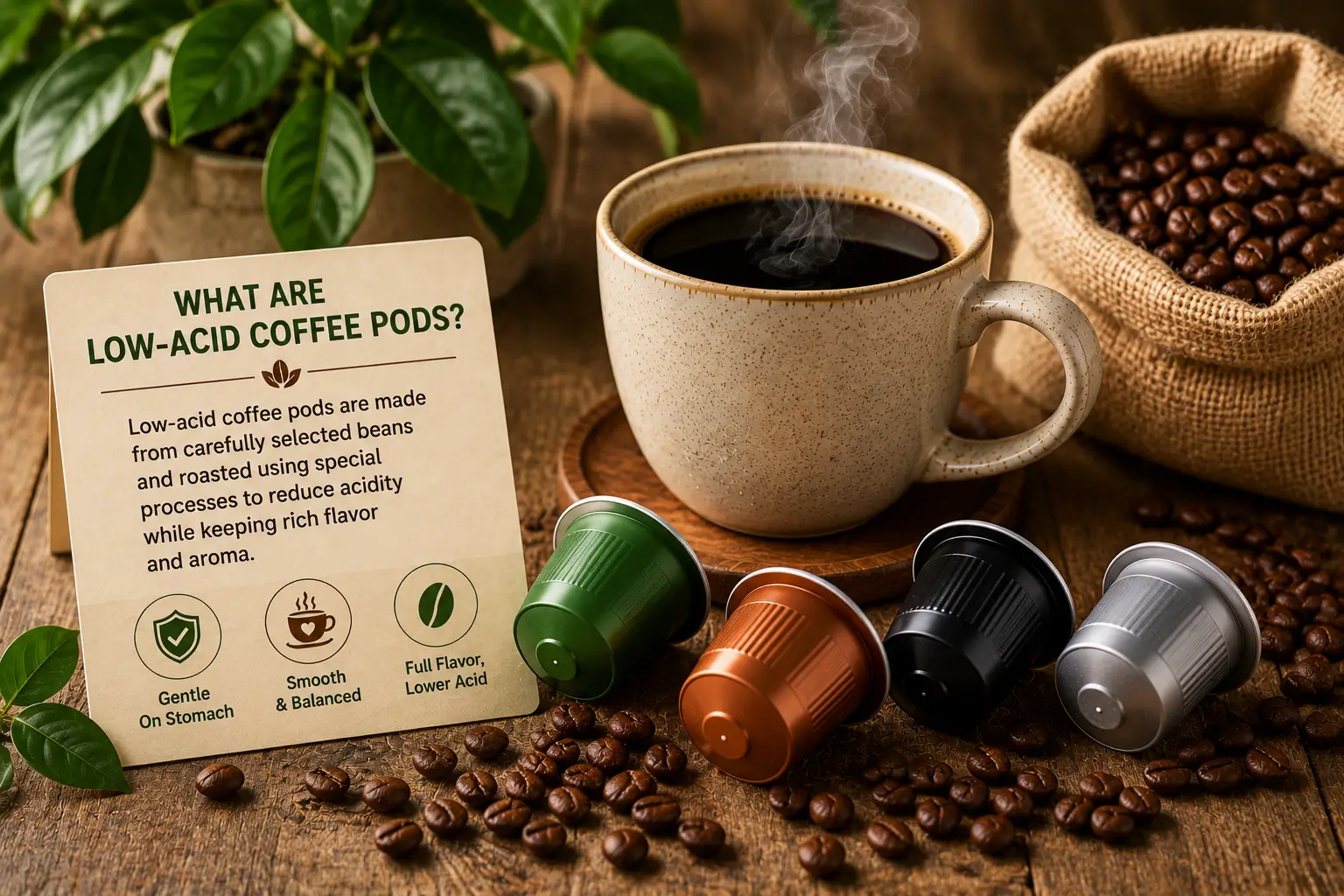
Low-acid coffee pods are single-serve coffees promoted as having a milder acidity profile. A company may use certain beans, roast levels, blends or processing methods to create that result.
The phrase can describe three different things:
Measured Acidity
The chemical acidity of brewed coffee, which can be described using pH, titratable acidity or concentrations of specific acids.
Perceived Acidity
The bright, fruity, sharp or sour sensation you taste. Sensory acidity does not map perfectly to one pH value.
Digestive Tolerance
Whether a specific coffee causes heartburn, stomach discomfort or another symptom for you.
Marketing Claim
A brand may call a coffee low acid without publishing the test method or a direct comparison with its regular coffee.
Best Label Check
A stronger product claim explains what was measured, how it was measured, and what the coffee is being compared with. “Smooth” alone is mainly a flavor description.
Coffee pH, Titratable Acidity and Sour Taste Are Different
It is easy to treat “acidic” as one number, but coffee chemistry is more complicated.
| Term | What It Describes | Why It Matters |
|---|---|---|
| pH | Hydrogen-ion activity at the time of measurement | Useful chemical measure, but not a complete flavor or reflux score |
| Titratable acidity | The amount of base needed to neutralize acids to a chosen endpoint | Can differ even when two coffees have similar pH |
| Organic / chlorogenic acids | Specific acid compounds in coffee | Their levels change with bean, roast and brewing |
| Perceived acidity | How bright, sharp, fruity or sour coffee tastes | A sensory experience, not a direct GERD test |
This difference matters because a pod can taste smooth without being dramatically different in pH, and two coffees with similar pH may have different total titratable acids.
Why Is Coffee Acidic?
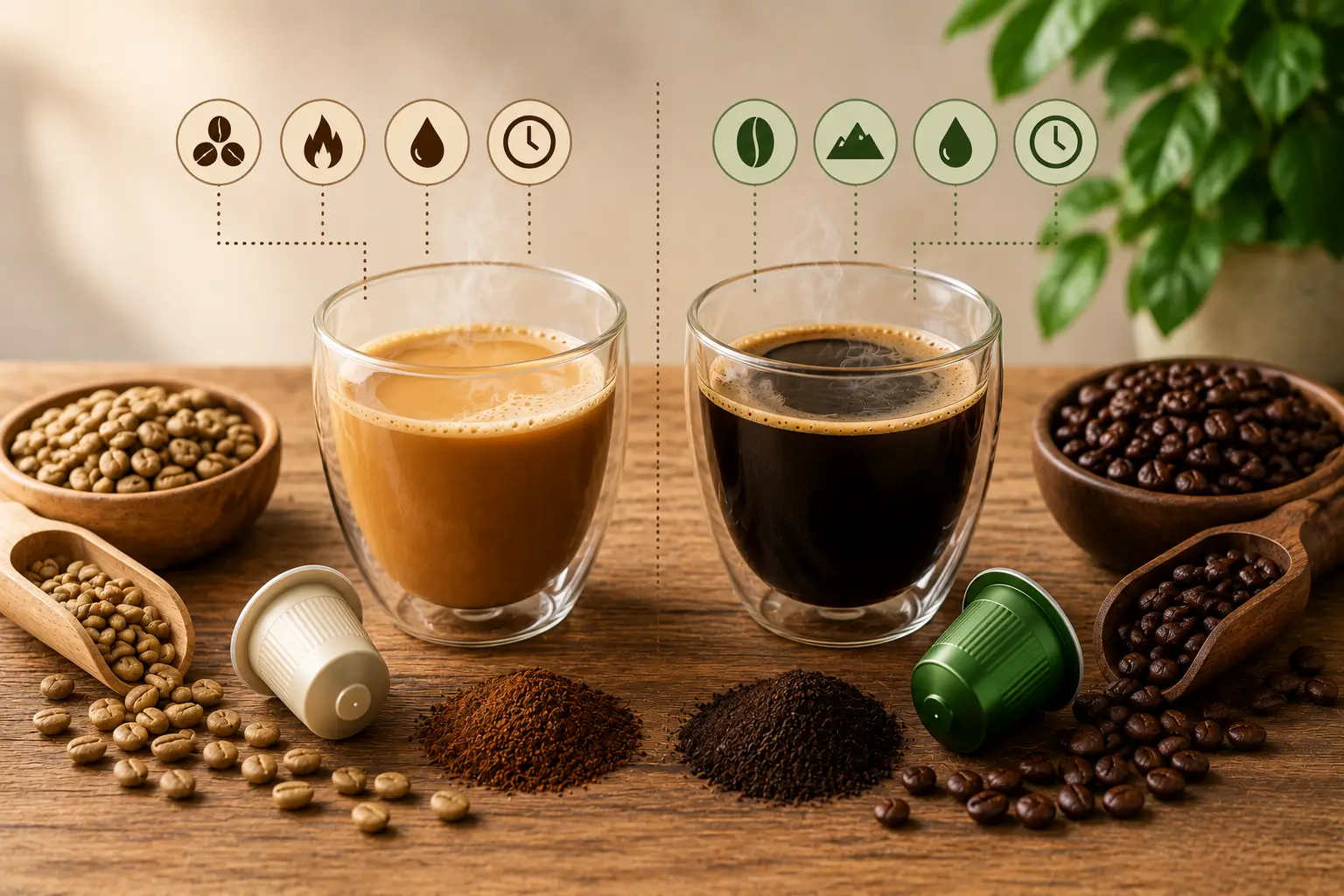
Coffee naturally contains many organic acids and chlorogenic acids. They help create flavor and aroma. Their concentrations change with bean species, roast level, growing conditions and brewing method.
A large review of coffee chemistry found that roasting changes different acids in different directions. Chlorogenic acids generally decrease as roasting progresses, while some organic acids can behave differently. That is why “darker = no acid” is not scientifically accurate.
Acidity is also not automatically a defect. Bright acidity is a valued flavor trait in many specialty coffees. Low-acid pods mainly serve people who prefer a rounder, less sharp taste or want to test whether a different coffee fits their symptoms better.
Can Low-Acid Coffee Pods Help With Acid Reflux or GERD?
They may feel better for some people, but low-acid coffee is not a proven GERD treatment.
GERD happens when stomach contents move back into the esophagus. That process is different from the simple fact that brewed coffee contains acids.
NIDDK lists coffee and other caffeine sources among drinks that some people report as GERD triggers. It also emphasizes that triggers differ between individuals. The American College of Gastroenterology similarly recommends avoiding foods or drinks that trigger your own symptoms rather than applying one universal diet to everyone.
| Your Main Problem | What May Be Worth Testing | What Not to Assume |
|---|---|---|
| Sharp or sour taste | A smoother medium/dark roast or clearly labeled low-acid blend | Less sour taste does not guarantee better GERD control |
| Symptoms after caffeine | Decaf or half-caff | Lower caffeine does not make coffee acid-free |
| Symptoms after large cups | Smaller serving and fewer total coffees | The brand alone is not necessarily the problem |
| Nighttime reflux | Earlier coffee and avoiding food close to bedtime | A “low acid” label does not override timing |
| Symptoms after rich add-ins | Review high-fat creamers and large specialty drinks | The coffee itself may not be the only trigger |
What Does the 2026 Coffee-and-GERD Meta-Analysis Add?
A 2026 systematic review and meta-analysis combined 40 studies with 122,074 participants. GERD was somewhat more common among coffee drinkers than non-drinkers, with a pooled odds ratio of 1.18.
That sounds important, but the study had very high heterogeneity between included studies, and the authors said the clinical importance of the association was unclear. They also concluded that routine universal coffee avoidance needs more research.
What This Means for a Low-Acid Pod Shopper
Do not treat one “GERD-friendly” label as proof. A better approach is to test your own trigger pattern while using established GERD guidance. If regular coffee repeatedly causes symptoms, changing coffee type may help you learn something, but it is not a substitute for medical evaluation or treatment.
For nighttime symptoms, NIDDK and ACG guidance support leaving roughly 2–3 hours between eating and lying down. Personal trigger avoidance is also reasonable when you can identify a repeatable pattern.
How to Choose Low-Acid Coffee Pods
- Read the exact claim: does the company give pH, compare acid content, explain a process, or simply say “smooth”?
- Confirm compatibility: K-Cup, Nespresso Original and Vertuo are different systems.
- Check caffeine: use regular, half-caff or decaf based on your caffeine needs.
- Choose taste separately: medium and dark roasts may taste smoother, but that is not a medical guarantee.
- Check ingredients: flavored or specialty pods may contain additional ingredients.
- Review portion size: a smaller cup may be easier to evaluate than several large servings.
- Compare cost per serving: “low acid” products can carry a price premium.
For pack-size math, see Coffee Pods Cost Per Cup ↗.
How CoffeePodH Treats Low-Acid Claims
CoffeePodH has not independently measured the pH or digestive effects of individual pod brands on this page. Unless a manufacturer publishes testing, a low-acid claim remains a product claim rather than proof of a medical benefit.
Light vs Dark Roast: Which Is Less Acidic?
Light roasts often taste brighter or fruitier. Dark roasts often taste deeper, more bitter or smoky. That sensory difference can make dark roast seem “less acidic.”
Chemically, the answer is more complex. A broad meta-analysis of coffee acids found that roasting reduces chlorogenic acids but can increase or decrease different organic acids. A 2024 laboratory study also found that coffee-extract pH changed non-linearly as roast progressed.
A small clinical study in nine healthy volunteers found that one dark-roast blend stimulated less gastric acid secretion than the medium-roast blend used for comparison. The two coffees also differed in several compounds besides roast level. The study does not prove that all dark roasts prevent heartburn or are safer for GERD.
| Roast | Typical Flavor Direction | Best Interpretation |
|---|---|---|
| Light | Bright, fruity, floral | May taste more acidic; do not assume worse digestive tolerance |
| Medium | Balanced sweetness and roast | Acidity varies greatly by bean and product |
| Dark | Roasted, smoky, bitter | Often tastes less bright; not a proven GERD treatment |
See Coffee Pods by Roast Type ↗.
Arabica vs Robusta: Does Bean Type Matter?
Bean species changes coffee chemistry. A large acid-composition review found that roasted Robusta had more total measured organic acids than roasted Arabica in the compiled studies, while chlorogenic-acid levels depended strongly on roast level.
Robusta also generally contains more caffeine than Arabica. However, this does not justify a simple rule that “Arabica is safe for reflux” or “Robusta causes heartburn.” The final drink depends on the specific blend, roast, extraction and serving size.
If you mainly want less caffeine, a decaf or half-caff label is more directly useful than relying on “100% Arabica.”
Is Decaf Better for a Sensitive Stomach?
Decaf has much less caffeine than regular coffee. That can be useful if caffeine appears to be part of your trigger pattern.
But decaf still contains coffee acids and other compounds. ACG guidance does not support decaf as a universal GERD solution, and individual response varies.
Low Acid
Focuses on acidity or a smoother taste. It may still contain full caffeine.
Decaf
Focuses on removing most caffeine. It can still be acidic and can still trigger symptoms.
Half-Caff
Reduces caffeine compared with regular coffee but does not define acidity.
Low-Acid Decaf
Combines two different product goals. Check whether both claims are actually explained.
See Decaf Coffee Pods ↗.
Is Cold Brew Always Lower Acid?
No. “Cold brew is much less acidic” is often stated too simply.
Laboratory comparisons have found that cold brew can have lower titratable acidity than hot-brewed coffee, but pH can be quite similar. One study comparing six coffees found hot and cold brew pH values in a similar range, while hot brew contained more titratable acids.
That means cold brew may taste smoother or contain fewer titratable acids under some brewing conditions without becoming non-acidic. It also does not prove that a hot-brewed pod labeled low acid will be worse for reflux.
Do Not Transfer Cold-Brew Claims to Pod Coffee
A standard K-Cup or Nespresso capsule uses hot-water extraction. A general cold-brew finding does not automatically describe the chemistry of your hot-brewed low-acid pod.
Low-Acid K-Cups vs Nespresso Capsules
Choose machine compatibility first. The words “low acid” do not override pod-system design.
| Format | What to Check |
|---|---|
| K-Cup-compatible pod | Confirm compatibility with your Keurig or K-Cup-style brewer |
| Nespresso Original-compatible capsule | Confirm Original-line compatibility; this does not imply Vertuo compatibility |
| Nespresso Vertuo capsule | Vertuo uses its own capsule system; third-party low-acid choice is more limited |
| Reusable pod | Confirm the reusable pod fits your machine, then choose the ground coffee separately |
There is no brewer format that guarantees lower acidity. Compare the actual coffee product.
For system differences, see Nespresso vs Keurig ↗.
Practical Tips for Testing a Smoother Coffee Routine
- Change one variable at a time. Try one different roast or low-acid product before changing coffee, milk, meal timing and portion all together.
- Track the serving size. A larger volume may affect you differently from a small espresso.
- Consider caffeine. Try decaf or half-caff if symptoms seem linked to stimulation.
- Review high-fat add-ins. High-fat foods are a common reflux trigger for some people.
- Move late coffee earlier. Nighttime reflux and caffeine-related sleep disruption can overlap.
- Do not assume “smooth” means medically safer. Use your repeatable symptom pattern.
- Stop testing a product that consistently causes discomfort.
If late coffee also affects sleep, see Can Coffee Pods Affect Sleep? ↗.
Are Low-Acid Coffee Pods Healthier?
Not automatically. “Low acid” describes one product characteristic or claim. It does not tell you the full nutritional or health profile.
A low-acid pod can still be high in caffeine. A sweet specialty version can still contain sugar or dairy ingredients. A regular pod that you tolerate well is not automatically “less healthy” because it does not carry a low-acid label.
For the broader health picture, see Health Benefits and Risks of Coffee Pods ↗ and Caffeine in Coffee Pods ↗.
When Should Reflux or Stomach Symptoms Get Medical Advice?
Frequent or worsening heartburn should not be managed only by switching coffee brands.
- Symptoms happen repeatedly despite routine changes.
- You have trouble or pain when swallowing.
- You have persistent vomiting.
- You have unexplained weight loss.
- You notice signs of gastrointestinal bleeding.
- You develop new or severe chest pain.
Chest Pain Is Not a Coffee Test
New or severe chest pain needs appropriate urgent medical assessment. Do not assume it is reflux just because it happened after coffee.
Frequently Asked Questions
They are single-serve coffees marketed or formulated for lower measured acidity, a smoother flavor, or both. Check what the manufacturer actually means by the claim.
No. Coffee naturally contains several acids. “Low acid” normally means lower acidity compared with something else or a less sharp sensory profile, not zero acid.
No product can guarantee that. Coffee may still trigger reflux because of caffeine, serving size, timing, other coffee compounds or individual sensitivity.
It may be easier for some people to tolerate, but it is not a GERD treatment. Current guidance favors identifying personal trigger foods and drinks rather than assuming one coffee type works for everyone.
Not completely. pH is one chemical measure. Titratable acidity, individual acid compounds, aroma and other coffee chemistry also affect perceived acidity.
Dark roast often tastes less bright, but different acids change in different ways during roasting. Roast level alone does not reliably predict pH or reflux symptoms.
Bean species changes coffee chemistry, and research has found differences in organic-acid levels. But Arabica alone does not guarantee a low-acid brew or better digestive tolerance.
Not necessarily. Acidity and caffeine are different characteristics. A low-acid pod can still be fully caffeinated.
Not automatically. Decaf removes most caffeine, but it does not remove all coffee acids. Look for a separate low-acid claim if that is your goal.
Cold brew often has lower titratable acidity in laboratory comparisons, but pH can be similar to hot brew. “Cold brew is non-acidic” is not accurate.
Choose products specifically labeled compatible with your Keurig or K-Cup-style brewer. Check the exact machine and product before buying.
Yes. Some brands sell low-acid coffee in K-Cup-compatible formats. The pod format itself does not determine acidity; the coffee inside does.
Some Original-compatible third-party products may make low-acid claims. Confirm the exact system because Original-compatible capsules do not fit Vertuo machines.
Not automatically. Overall health depends on caffeine, ingredients, serving pattern, your medical context and the rest of your diet.
Look for a repeatable pattern and change one factor at a time, such as serving size, caffeine, timing or coffee type. Frequent or worsening reflux should be discussed with a clinician.
Conclusion
Low-acid coffee pods can be a useful way to try a smoother cup without leaving a single-serve system. The best choice is one that clearly explains its acidity claim, fits your brewer, matches your caffeine needs and tastes good to you.
Do not treat “low acid,” “dark roast,” “Arabica,” “decaf” or “cold brew” as guaranteed reflux solutions. Coffee chemistry and GERD are more complex than one label. If coffee repeatedly triggers heartburn or digestive symptoms, use your own symptom pattern and professional medical advice rather than relying on a product promise.